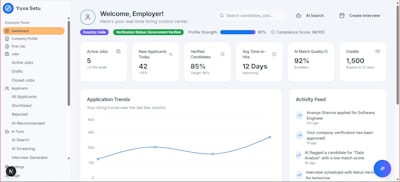
The corporate intranet is once again a protagonist in 2026, but no longer as a simple document repository. Companies looking for long-term cost savings turn it into an operating platform with smart onboarding, automation and analytics. This approach transforms an employee's experience from day one and, at the same time, eliminates inefficiencies that accumulate over the years.
An intranet with smart onboarding is not just about welcoming people. It guides each person through a personalized itinerary based on their role, access rights and goals. It interacts with HR, management and knowledge systems, and automates administrative tasks. The result is faster integration, fewer errors and more visibility for those responsible for the area.
Long-term savings come from several sources. First, manual work reduction: tasks that used to require emails, forms and follow-up can now be recorded and executed by the platform. Second, tool consolidation: many organizations pay licenses for multiple applications with overlapping functions. A smart intranet can unify processes without forcing a costly replacement of critical systems overnight.
Invisible costs also count. Employee turnover has a direct impact on budget, and part of that turnover is caused by a poor initial experience. When an employee quickly understands their role, accesses the right information and feels the company is investing in their adaptation, the likelihood of staying increases. That effect appears in retention metrics and in the continuity of internal knowledge.
Another factor is regulatory compliance. In regulated sectors, an unstructured onboarding process can lead to unauthorized access, incomplete training or poorly documented evidence. An intranet with access profiles, traceability and security policies reduces that risk and prevents penalties. It is one of the savings items most often forgotten when calculating return on investment.
Scalability completes the financial argument. Growing companies cannot endlessly multiply the cost of coordinating people with manual processes. An intranet with smart onboarding allows dozens or hundreds of employees to be incorporated without HR or IT becoming the bottleneck. The initial investment is amortized with every new hire.
Designing an intranet with smart onboarding also means rethinking corporate knowledge. Documentation is usually scattered across folders, emails and people. The intranet can centralize and structure it by role, reducing search time and preventing employees from having to ask colleagues. This cultural change is as important as the technical one.
To achieve all this, a generic solution is not enough. Each organization has different policies, hierarchies, tools and flows. That is why custom software offers a clear competitive advantage: it adapts to real processes instead of forcing the company to adapt to a closed product. Q2BSTUDIO designs software that integrates with the existing ecosystem, from management systems to collaboration tools.
AI and AI agents take this concept one step further. A new employee can ask questions in natural language and get answers based on internal documentation, without depending on a person to reply. Agents can request equipment, create accounts, schedule training and escalate incidents. All within the intranet, with supervision mechanisms so that a person reviews critical decisions.
The quality of AI depends on the information that feeds it. Solutions such as RAG or models deployed on private infrastructure only offer reliable answers if the underlying documentation is current and accessible. Therefore, an intranet project must include a content governance model, with owners, reviews and freshness metrics.
The technical dimension is equally important. Deploying a smart intranet on the cloud AWS/Azure infrastructure makes it possible to scale storage and computing capacity according to the number of employees, while maintaining advanced security policies. Q2BSTUDIO uses private connections, VPN and encryption so that queries to AI models do not expose confidential information.
Cybersecurity is not an add-on; it is part of the design. An intranet centralizes sensitive data, so identity, roles and audits must be managed rigorously. Integration with Active Directory, encryption of data in transit and at rest, and activity logs allow companies to demonstrate proper governance. Skipping this step turns an improvement tool into an attack surface.
Employee experience also benefits from human-centered design. A well-thought-out digital onboarding reduces uncertainty in the first days, provides confidence and allows each person to deliver value sooner. HR teams stop chasing administrative tasks and devote their time to supporting, evaluating and improving the process.
To justify long-term savings, you have to measure them. A BI/Power BI module connected to the intranet shows average adaptation time, cost per hire, training completion rate and satisfaction level. With this data, management can make better decisions and demonstrate the return of each initiative.
Q2BSTUDIO approaches these projects with a discovery phase in which current processes, pain points and baseline indicators are analyzed. It then proposes a phased plan, with a functional prototype in a few weeks. This methodology makes it possible to validate the value of the intranet without waiting for a long, expensive implementation.
Integration is another critical factor. The intranet must coexist with the ERP, CRM, HR tools and productivity suites. Replacing the entire ecosystem is expensive and unnecessary. Q2BSTUDIO prefers to extend what already works and add value where the current process creates friction.
Budget does not have to be a barrier. A phased deployment allows starting with a small scope and expanding only when results are visible. Most investments are recovered through fewer administrative hours, better retention and fewer errors.
A project of this nature usually has a return on investment within six to twelve months. Reducing administrative tasks frees up team time, automation reduces errors and centralized information improves decision-making. From the first year onwards, savings become recurring.
The key is not to treat smart onboarding as a welcome page. It is a platform that combines custom software, AI, automation, analytics and security. Companies that understand this obtain a sustainable advantage over those that limit themselves to digitizing forms.
In 2026, the challenge is not having more technology, but integrating it into the processes that generate value. An intranet with smart onboarding is one of the most direct ways to achieve this, provided it is designed with a product vision, not as a simple IT project. Q2BSTUDIO recommends starting with a limited pilot, measuring results and expanding the solution based on evidence. This approach reduces risk and allows investment to be adjusted to the organization's capacity. Long-term savings are not an abstract promise; they are built with metrics, well-integrated technology and a clear business vision.