The intranet with smart onboarding has become a strategic lever for companies that want to grow without losing efficiency. For a long time, the intranet was limited to publishing documents and internal news. Today, however, a well-designed intranet can manage the full employee lifecycle: from the first point of contact with the company to team integration, including continuous training and performance measurement.
The term smart onboarding refers to an automated, personalized and data-driven process. Instead of overwhelming people with generic information, the system detects their role, interests and gaps, and offers exactly what they need at each moment. Artificial intelligence makes it possible to recommend content, answer questions through natural conversation and alert managers when a new employee is falling behind.
To make this possible, technology must work in the background. The first step is integrating the intranet with the tools the company already uses: ERP, CRM, communication platforms, HR systems and corporate directory. Without this integration, any task becomes a manual data transfer and the value of the process is lost. A custom software development architecture is necessary to adapt the platform to the reality of each business.
Q2BSTUDIO, a software development and technology company, approaches these projects with a results-oriented mindset. Its team analyzes current processes, identifies points of friction and designs a solution that fits the company culture. The goal is not to replace every tool on the market, but to create an intelligence layer that connects them and makes them work together.
One of the most valued aspects is flexibility. A generic solution can work in a standard environment, but when the company has a particular way of working, custom software makes the difference. This type of development makes it possible to modify flows, add fields, define permissions and adapt the interface without waiting for external updates.
Infrastructure matters too. It is now common to deploy the intranet on AWS or Azure cloud, which guarantees service availability in different countries, the capacity to handle usage peaks and more efficient resource management. The cloud also facilitates integration with other artificial intelligence or data analytics services, so the platform can evolve as business needs grow.
Security is a critical factor, especially when managing personal data, payroll or confidential project information. An intranet must comply with regulations, enforce role-based access control and keep activity logs to audit who has viewed or modified each piece of content. Cybersecurity measures must be part of the initial design, not added later, because a failure in this area can destroy years of trust.
AI agents represent the next level in intranet evolution. Unlike a conventional search engine, an agent can execute actions: create a ticket, update a profile, request approval or schedule a follow-up interview. These digital assistants, configured by business teams, reduce operational workload and allow people to focus on higher-value tasks.
Automation also has a direct impact on employee experience. Traditional onboarding means filling out forms, waiting for approvals and asking colleagues where to find each resource. With a smart intranet, many of those tasks happen automatically: credentials are created, access is granted, training is assigned and introductions are scheduled without the new employee having to chase anyone.
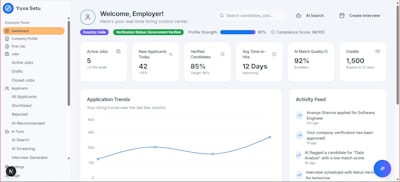
Decision-making improves when reliable information is available. A Business Intelligence module inside the intranet makes it possible to monitor indicators such as average time to productivity, training completion rate or performance evolution in the first months. With Power BI dashboards, managers can compare results across teams, departments or countries and identify opportunities for improvement.
We must not forget that technology must serve people. A smart onboarding intranet only makes sense if users perceive an immediate benefit. Therefore, design must take care of navigation, speed and clarity of messages. Every extra click is an opportunity to lose the user, and every piece of information that is hard to find generates a support call.
Adoption also depends on communication and leadership. Middle managers should be the first to use the platform and demonstrate its advantages. If team leaders actively use the intranet, the rest of the organization sees it as a standard rather than an imposition. Cultural change is as important as technical implementation.
From an economic point of view, a smart onboarding intranet has a clear return. It reduces hours spent on administrative tasks, accelerates new employee productivity and decreases turnover caused by poor initial experiences. These benefits accumulate month after month and more than compensate for the initial technology investment.
For companies operating in several countries, a centralized intranet facilitates process consistency without eliminating local particularities. The platform can display content in different languages, adapt policies to local legislation and offer each subsidiary a personalized view. Q2BSTUDIO designs solutions with this global mindset, because growth no longer understands borders.
Integrating AI agents with internal data requires a rigorous approach. Connecting a language model to the intranet is not enough; it is necessary to define what information it can query, under what conditions and with what level of transparency. Q2BSTUDIO's work in applied artificial intelligence solutions allows companies to implement this technology with guarantees, without compromising security or privacy.
In short, betting on a smart onboarding intranet is a business decision more than a technological one. Technology is the means; the end is building an organization capable of growing sustainably. When processes are clear, information is accessible and people are supported by intelligent systems, the company becomes more competitive and better prepared for future challenges.