
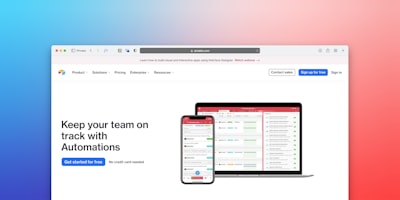
The professional intranet has stopped being a simple repository of documents and internal announcements. In Valencia, companies that want to be more efficient need a digital space where communication, data and workflows coexist in the same environment. An intranet with workflow automation allows every department to run critical processes without relying on loose emails, scattered spreadsheets or manual approvals.
When an organization grows, the hidden cost of disorganization grows with it. Employees waste time searching for information, duplicating tasks and waiting for answers that should be immediate. A professional intranet solves that problem by centralizing knowledge and connecting the tools already used every day. Instead of navigating between applications, the team accesses a single point of work with up-to-date information.
A generic intranet can cover basic needs, but the competitive advantage appears when the system adapts to the company's actual operations. Custom software makes it possible to model departments, permissions, approvals and notifications according to specific business rules. The idea is not to force the process to fit a tool, but to build the tool around the process.
From a technical point of view, a solid architecture relies on three pillars: modular applications, integrations with management systems, and data governance. The intranet must connect with ERP, CRM, Active Directory and office suites without friction. That level of integration requires well-documented APIs and a coherent data model, something that can only be achieved with a medium-term development strategy.
Q2BSTUDIO approaches these projects as an engineering exercise, not as a simple product installation. Their team analyzes current processes, identifies bottlenecks and proposes a roadmap that combines web development, automation and analytics. The goal is to make the intranet more than a corporate showcase: a work tool that produces measurable results every day.
Artificial intelligence expands the value of the intranet with features that seemed impossible a few years ago. An internal assistant can summarize long documents, answer questions about company policies or classify support requests automatically. AI agents go one step further and perform tasks: updating records, sending reminders, generating reports or escalating incidents. All of this can fit into an intranet with the right supervision.
Automation governance is also essential in a modern work environment. It is not about removing human oversight, but about giving every process a clear owner. Workflows can include escalation rules, time limits and pre-flight checks before a sensitive action is executed. In this way, the company combines machine speed with human judgment.
Automation cannot thrive without trust. That is why cybersecurity must be present from the first line of code: role-based access control, data encryption, audit trails and robust authentication mechanisms. When employees know that information is protected and every action is recorded, the system becomes a reliable source of work instead of a source of risk.
Cloud deployment makes scalability and business continuity easier. A professional intranet can be hosted on Azure or AWS cloud infrastructure, allowing resources to be adjusted on demand and automatic backups to be maintained. This architecture also simplifies secure access from offices, warehouses or remote work, provided that perimeter security policies and network segmentation are applied.
For management to make decisions, the intranet must turn data into knowledge. Dashboards and business intelligence platforms such as Power BI make it possible to visualize activity indicators, each team's workload and resolution times. In this way, the intranet stops being a document container and becomes the operational governance center of the company.
Integration with Microsoft tools also plays an important role. Active Directory simplifies user and permission management; Microsoft Teams allows the intranet to sit inside the natural flow of conversation; SharePoint can act as a complementary document layer. A good integration strategy avoids duplication and preserves the investment already made in those systems.
A successful implementation must follow a realistic plan. The first step is usually a pilot in the area with the highest administrative workload. Then it is extended to other departments, permissions are adjusted and workflows are refined with user feedback. Process automation is not implemented all at once; it is built in phases to reduce impact and ensure adoption.
The employee experience also improves with an intranet that learns from usage. For example, when searching for a document, the system can show content related to the role; when requesting holidays, the flow is automatically directed to the right manager; when receiving an invoice, the application validates it and sends it to the finance area. These small automation changes, added together, save many hours every month.
Technology adoption depends as much on the tool as on training. A professional intranet includes help materials, training sessions and support channels so employees lose their fear of automation. When the team understands how it makes work easier, initial resistance becomes a demand for new features.
The results of a professional intranet with automation show up in concrete indicators: fewer hours spent on administrative tasks, faster approvals, fewer errors and a better employee experience. Moreover, by freeing up team time, the organization can dedicate more resources to valuable activities: innovation, customer service and commercial growth.
Q2BSTUDIO combines business vision with the technical ability of a team specialized in web development, AI, cloud and cybersecurity. Its projects also include training so that the client can manage the system independently. In this way, the intranet evolves with the company, incorporating new functionality without depending on a supplier for every change.
In the business fabric of Valencia, where industrial SMEs, technology companies and service firms coexist, an intranet with workflow automation is a clear competitive advantage. The sector does not matter: any organization that works with information and collaborative teams can benefit from a well-designed, secure and results-oriented digital environment.
The question is not whether it is worth modernizing the intranet, but when to start. Companies that wait until the problem becomes urgent assume a high opportunity cost. Those who take the step with the right technology partner gain agility, order and analytical capacity. Evaluating a professional intranet with workflow automation project in Valencia is the first step to transforming the way of working.

