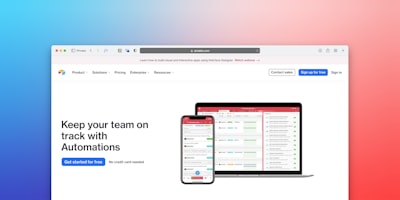
Can business app development automate manual tasks? The short answer is yes, but the useful answer is more nuanced: it can, as long as automation is designed with a deep understanding of processes, an integrable architecture, and a continuous improvement mindset. A business application is not just a digital form; it is a piece of engineering that orders business logic, assigns responsibilities, and triggers actions.
In many companies, manual tasks still occupy a large share of the working day: entering invoice data, reconciling transactions, validating requests, generating periodic reports, updating customers in the CRM, or forwarding notifications between departments. These activities are necessary, but repetitive and error-prone. Automation can free people from that mechanical work, but not in an improvised way. It requires applications that model processes, capture the right data, and connect with the rest of the digital ecosystem.
Custom software development is the most effective way to automate with purpose. A generic platform can standardize a form or a simple flow, but a real process includes exceptions, approvals, priorities, deadlines, roles, and legacy systems. Custom software can represent that complexity without forcing the company to change how it works to fit a rigid template. Process automation with software is not just about chaining tasks; it is about designing a system that knows what to do in each situation, when to escalate a problem, and what information to record.
It is often thought that automating means programming a robot that executes steps. In reality, the greatest value appears when complete decisions are automated. For example, a business application can classify an incoming request, check the business rules, detect if data is missing, and automatically request a correction. If the request is valid, it is approved based on predefined limits or routed to a manager. Everything is recorded. That is an intelligent workflow, not a simple script.
Artificial intelligence has taken this capability to another level. With AI techniques, an application can read unstructured documents, extract dates, amounts, and concepts, identify anomalies in invoices, or anticipate supply problems. It is not about replacing people, but about drastically reducing the time spent on tasks that do not add value. In addition, AI agents make it possible to automate more complex processes: an agent can query multiple data sources, resolve an incident, and deliver a summary to the human team before executing a sensitive action.
Infrastructure matters too. Responsible automation needs scalable and secure environments, and AWS/Azure cloud provides a solid foundation for running processes, storing data, and deploying analytics. At the same time, cybersecurity cannot be an afterthought. Every integration is a potential attack surface. Therefore, business app development must include robust authentication, encryption, access control, and audit logs. Automation increases speed, but also responsibility over data.
Any automation program needs indicators. A company should not ask only how many hours it saves, but which processes are slower, which ones register more errors, and where delays accumulate. With BI/Power BI tools, it is possible to visualize process status, compare times between teams, and discover bottlenecks. Analytics makes it possible to prioritize the next automations with objective data and demonstrate return on investment.
This way of working cuts across sectors. A distribution company can automate order entry and route planning; an insurance company, claims processing; an industrial firm, reconciliations between delivery notes and invoices; a financial institution, fraud prevention and compliance alerts. In all these cases, business app development acts as a nervous system that connects people, data, and applications. Technology becomes a strategic asset, not an isolated expense.
In an automation project, human review remains essential. A well-designed application marks which operations require supervision, who must approve a change, and how each decision is documented. In this way, technology takes over the mechanical parts and people retain control over exceptional cases. That combination builds trust and prevents a small failure from becoming a systemic problem.
Q2BSTUDIO develops business software with this comprehensive approach. Its team analyzes processes, identifies manual workloads, proposes a roadmap, and builds custom applications that integrate AI, automation, cloud, and analytics in the same project. It does not limit itself to delivering code: it supports deployment, training, and product evolution. Thanks to that vision, companies can move from a model based on manual work to a model where people focus on decisions and customer relationships.
A realistic roadmap is as important as the technology. Instead of trying to automate the whole company in a single project, it is better to prioritize processes with the highest volume, frequency, and error cost. For each flow, objectives, indicators, owners, and acceptance criteria are defined. Then a first version is deployed, metrics are collected, logic is adjusted, and scope is expanded. This incremental approach reduces risk and lets users validate the solution in a real environment. Q2BSTUDIO applies this methodology in every delivery: first it understands the process, then it builds a minimal viable product, puts it into production, and keeps iterating until the expected business effect is achieved.
In addition, a well-executed automation project improves employee experience. When people stop copying data between systems and chasing approvals, the working climate improves and the organization can respond faster to market changes. Confidence in software grows when teams see that applications respect their judgment and give them time back. That cultural change is as important as saving hours, because it sustains transformation over the long term.
The question of whether business app development can automate manual tasks has a positive answer, but with conditions. Automation creates value when there is a clear process, technology that adapts to business logic, and a culture that trusts data. Organizations that start with small flows and then scale to complete processes usually achieve more sustainable results. The goal is not to eliminate every manual step, but to eliminate those that do not add value and leave room for work that requires judgment, empathy, and creativity.