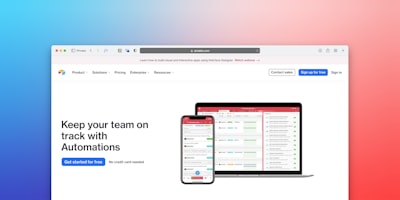
The corporate intranet is no longer a simple portal for news and documents. In 2026, companies in Málaga need that internal environment to support real processes: approvals, incidents, onboarding, internal purchasing, technical knowledge queries and coordination between departments. When that level of demand arrives, the question is no longer how to create a prototype, but how to take an intranet that automates workflows into production without putting the operation at risk.
This article takes a technical and business perspective aimed at executives, IT managers and architects evaluating this transformation. The goal is not to offer a list of features, but to explain what it actually means to operate an automated intranet: prepared architecture, aligned security, governed data, repeatable deployment and business visibility. It can also be useful as a guide to identify the capabilities that the team accompanying the project must have, because the final value is not only in the technology, but in how it is integrated with the processes that already exist.
Málaga has become a relevant technology hub in southern Europe, and companies competing from this city have the opportunity to use their intranet as a strategic advantage. A well-built intranet reduces the time each employee spends looking for information, accelerates the onboarding of new talent and enables operational decisions to be made with up-to-date data. The next step is to turn those workflows into automations that do not depend on emails, spreadsheets or manual interventions.
The difference between a demonstration environment and a production system is enormous. A prototype can show a virtual assistant, an automatic approval or a dashboard, but only a production deployment guarantees that those capabilities work with real users, confidential data and demanding schedules. For this reason, the focus must be on issues such as architecture review, database quality, backup strategy, access control, monitoring and an incident response plan.
Q2BSTUDIO is a software and technology development company that supports this kind of initiative from discovery to post-launch support. Its approach combines custom software, AI, cybersecurity, cloud AWS/Azure and BI/Power BI so that the intranet is not a container of information, but an execution platform. This comprehensive view is especially useful when the intranet must integrate with legacy systems, Active Directory, Microsoft environments or the organization's own APIs.
The first step in a workflow automation project is usually a diagnosis of current processes. It is important to identify which tasks are repeated frequently, where bottlenecks occur, which integrations are required and what data is involved in each decision. With that information, a realistic starting point can be defined and automating poorly standardized processes can be avoided. The right technology does not fix a badly designed workflow; it accelerates the way the workflow runs, and if the workflow has errors, they multiply.
The automation of software processes is not limited to sending notifications. In a corporate intranet, it can include request creation, task assignment, document approval, time tracking, report generation and coordination between teams. For it to work in production, each step must have a clear owner, process traceability must be recorded, and mechanisms must exist to handle exceptions. Automation should reduce workload, not create a new layer of friction.
Artificial intelligence expands the possibilities of an intranet even further. An internal AI search engine can answer questions based on company documentation, summarize long internal policies or guide an employee through a procurement process. AI agents can classify tickets, draft initial responses, detect duplicate information or suggest the next step in an approval flow. In this context, technologies such as Azure AI Foundry make it possible to deploy models with access to corporate data, as long as access policies are well defined and strict information control is maintained.
One of the keys to making AI useful on the intranet is the use of RAG, that is, retrieval augmented generation. Instead of the model answering from general knowledge, relevant fragments of internal documentation are provided so that the answer is based on verifiable sources. This requires good content organization, a constant updating process and a way to measure the quality of responses. AI must know how to recognize when it does not have enough context and, in that case, communicate it or escalate it to a person.
You cannot talk about production without talking about cloud AWS/Azure. Cloud infrastructure offers flexibility, scalability and disaster recovery options, but it also forces configuration decisions that directly affect security and cost. In a corporate intranet, it is common to combine managed services, databases, identity and private networks so that sensitive data does not leave the trust boundary. Integration with Microsoft Teams, SharePoint or Active Directory is usually part of this architecture, and all these elements must be documented so that the internal team can operate them without depending on one person.
Cybersecurity must be present from day one. An automated intranet manages sensitive information: employee data, contracts, customers, suppliers and strategic decisions. Therefore, role-based access control, multi-factor authentication, audit logging and data leak protection are essential requirements. It is also important to review API configurations, cloud connection points and external user access if the intranet has extensions for suppliers or collaborators. Cybersecurity is not a final phase; it is a condition that crosses the entire system life cycle.
Observability is another pillar of production. It is not enough to know that the intranet is active; you need to know the response time of each service, the number of processes that finish successfully, the latency of database queries, resource consumption and errors that appear during operation. With a good monitoring system, the team can anticipate problems and correct them before they affect users. Alerts should be action-oriented, not noisy: each alert should indicate what is happening and which team should intervene.
Business intelligence turns intranet data into useful information for management. A portal with Power BI can show workflow compliance, average approval time, volume of requests by department, employee satisfaction or hours saved thanks to automation. These dashboards are essential to justify the investment and to detect future improvements. Indicators must be defined before launch, otherwise it will be very difficult to compare the initial situation with the results obtained after automation.
Regarding timing, a common methodology is to begin with a discovery phase and deliver an MVP in four to eight weeks. That first production environment allows the architecture, integration with internal systems and response of real users to be validated. From there, the project develops incrementally: workflows are added, integrations are expanded, AI models are adjusted and the dashboard is improved. This way of working reduces risk and allows the business team to see tangible progress from the start.
It is also important to plan knowledge transfer. The goal is for the client to manage AI, workflows and indicators autonomously. For this, Q2BSTUDIO usually delivers web administration portals, operational documentation and training sessions with the internal team. This allows minor changes, such as updating a frequent question or adjusting a workflow condition, not to depend always on the provider. Client autonomy is one of the factors that most influences the long-term sustainability of the project.
Change management is another aspect that should not be underestimated. Employees need to understand why a workflow is automated, what benefits they get and how they will resolve doubts when something does not work as expected. An intranet with automation requires a small cultural change: less dependence on email as a coordination tool, more trust in system records and a continuous improvement attitude. Companies that communicate these changes well usually get better results than those that install technology without explaining the context.
In short, taking an intranet that automates workflows into production in Málaga in 2026 is both a technical and business project. It is not about installing a tool, but about building a platform that improves the way people work. This requires a solid foundation: reviewed architecture, integrated security, automated deployment, data visibility and a team capable of supporting the process. Q2BSTUDIO brings that combination of custom software development, artificial intelligence, cybersecurity, cloud and business intelligence, with a practical approach that seeks measurable results and sustainable operation.