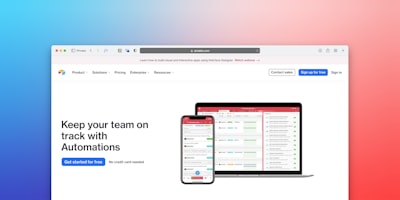
The corporate intranet has ceased to be a simple document repository. In Madrid, companies that want to compete with agility are turning their intranet into an operational platform where workflows are automated, data becomes decisions, and teams collaborate without friction. We are talking about an intranet with workflow automation, a concept that in 2026 has become a strategic priority for operations directors, IT managers and general managers. The need is not only technological: it is about business, efficiency and adaptability.
Madrid has a very diverse business fabric, with offices of large multinationals, expanding scaleups and SMEs with growth ambitions. In all these cases, information is usually scattered across shared folders, emails and applications that do not communicate with each other. The result is slow approvals, rework errors, loss of traceability and employees who spend hours on repetitive tasks. An intranet with workflow automation solves this fragmentation by connecting people, processes and systems in a single, organized environment.
Compared with a classic intranet, this new generation of platforms incorporates business logic. Publishing a policy or a manual is no longer enough; the system itself must execute tasks when an event occurs: a holiday request, an invoice pending approval, the onboarding of a new client or a support ticket. To achieve this, Q2BSTUDIO combines custom software development, integration with existing systems and process automation. The goal is for the intranet to act as an operational brain that knows who must do what, when and with which information.
Custom applications lie at the heart of this architecture. Every company has different business rules, reporting lines and responsibilities, and a generic solution cannot capture that complexity. By building a flexible intranet, it is possible to model real workflows, from a purchase request to the review of a contract. Q2BSTUDIO, as a custom software and technology company, designs these applications with a modular approach: critical processes are solved first, and then the platform expands to other areas of the organization.
A common mistake is to think that automation forces you to replace your ERP, CRM or office tools. In practice, a modern intranet acts as an orchestration layer connected to the systems that already exist. Q2BSTUDIO integrates SAP, Salesforce, Microsoft Dynamics, Odoo, HubSpot, SharePoint, Microsoft Teams and custom APIs, creating a unified experience without duplicating data or generating unnecessary license costs. In this way, the intranet is not another silo, but the point that connects all silos.
This automation layer is what dramatically reduces manual work. Instead of having a person copy data from an email to a spreadsheet, the system captures the information, validates it, sends it to the appropriate manager and logs every action. Q2BSTUDIO applies process automation with a pragmatic approach: bottlenecks that most affect the operation are prioritized, and impact is measured from the first month.
Artificial intelligence adds a layer of value that goes beyond transactional automation. Employees need to find information quickly, understand large volumes of data and get help with complex tasks. An intranet with AI can offer semantic search in natural language, automatic document summaries, responses based on internal policies and virtual assistants that guide users step by step. Q2BSTUDIO develops artificial intelligence solutions tailored to each company's context, with models deployed securely in private environments or in the cloud.
AI agents are one of the most impactful advances in this field. Unlike a simple bot, an agent can reason about a goal, consult multiple data sources, execute actions inside the intranet and learn from the results. For example, an agent can review an expense request, check whether it complies with policy, request approval from the manager and update the accounting record. Q2BSTUDIO integrates these agents as part of the flow, with human supervision checkpoints to ensure that important decisions remain under control.
Security and governance are starting conditions, not an afterthought. In an intranet with workflow automation, personal data, financial information and strategic documentation circulate. Therefore Q2BSTUDIO applies cybersecurity principles in every layer: authentication with role-based access control, audit logging, encryption in transit and at rest, and compliance with GDPR principles. When the intranet needs to communicate with on-premises systems, VPN tunnels and private addresses in Azure or AWS are used to avoid exposing the infrastructure to the internet.
Cloud deployment is another decisive factor. Q2BSTUDIO solutions run on AWS or Azure depending on each company's preferences, and scale vertically without the need to invest in hardware. In addition, the information generated by the intranet can be loaded into a data warehouse and exploited through BI/Power BI solutions. With Power BI dashboards, for example, executives can see in real time how many processes are pending, how long each approval takes and which areas have the most incidents. That visibility turns the intranet into a source of continuous improvement.
Implementing an intranet with workflow automation requires a clear method. Q2BSTUDIO begins with a discovery phase to analyze current processes, identify pain points and define success indicators. Then a minimum viable product is developed in four to eight weeks, allowing the solution to be validated with real users before it is rolled out. New integrations are then added, automation is expanded and the platform is deployed in production. This phased approach reduces risk and ensures every investment has visible returns.
Timelines and budgets depend on scope, integration complexity and the number of departments involved. In focused projects, investment usually starts around 5,000 euros and can exceed 60,000 euros in larger programs with AI and connections to multiple systems. What matters is not only the initial cost, but the operational savings generated by reducing manual hours, errors and delays. Most companies recover their investment within six to twelve months.
The benefits are not abstract. Automating a workflow eliminates intermediate steps that add no value and accelerates delivery. A procurement team can move from a three-day manual validation to automatic approval in hours, with escalation to a manager only in exceptional cases. An HR department can reduce the onboarding time of a new employee by automatically organizing all welcome tasks, training and system access. In general, companies see a significant reduction in repetitive work and a marked improvement in employee experience.
Q2BSTUDIO is a custom software and technology company that accompanies clients from idea to daily operations. Its team is made up of software architects, AI consultants, integration specialists and security experts. This combination allows complex projects to be handled with a single point of contact, avoiding the dispersion typical of working with multiple vendors. In addition, Q2BSTUDIO delivers source code and technical documentation, so the client does not depend on a black box to evolve its platform.
One of the most common concerns is autonomy after launch. Q2BSTUDIO solves this with an administration portal where business managers can configure AI prompts, review model costs, monitor executions and adjust workflows without writing code. This changes the relationship model: the internal team stops being a passive spectator and becomes the true owner of the solution. Technology adapts to the company, not the other way around.
Companies in Madrid that are still hesitating between investing in an intranet or waiting to see how the market evolves should consider the opportunity cost. Every week that passes, teams keep spending hours on tasks that could be automated, managers keep making decisions with partial data, and employees keep waiting for answers. An intranet with workflow automation is no longer a differential advantage: it is a condition for operating efficiently in an increasingly demanding environment.
In short, the choice of a technology partner should be based on results, not promises. Q2BSTUDIO stands out for its working methodology, its ability to integrate disparate systems and its practical knowledge of AI, cloud and automation. Every project begins with an honest diagnosis: if automation is not going to generate a clear return, this is said at the beginning. That transparency, together with code delivery and team training, explains why many companies trust Q2BSTUDIO to modernize their intranet and internal processes.
If your company in Madrid is considering an intranet with workflow automation, the next step is a free discovery session. In that conversation, processes are analyzed, improvement opportunities are identified and a realistic roadmap is proposed. Q2BSTUDIO offers a free 30-minute initial consultation to understand the context, answer questions and define the first steps. Digital transformation does not have to be complex if you have the right partner.