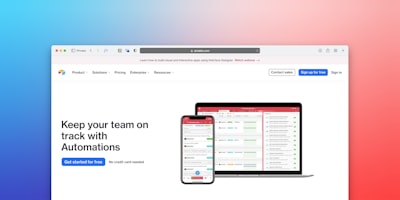
The corporate intranet has evolved from a static document consultation space into a collaborative and operational work platform. When workflow automation is added, the intranet becomes a strategic tool that connects teams, systems, and data in a single controlled environment. This evolution allows companies to manage internal processes with greater speed, traceability, and quality, while giving people more time to focus on higher-value activities.
A modern intranet should not be seen as a closed product, but as a solution built on flexible software. Every company has different ways of working, specific approval processes, and teams with different needs. For this reason, a strategy based on custom application development usually delivers better results than forcing generic tools to fit. By designing the system around real processes, friction is reduced, the employee experience is simplified, and existing data is used more effectively.
When we talk about workflow automation within the intranet, we are not referring only to automatic notifications. We mean intelligent forms, business rules, approval routes, task assignment, document generation, and connection with external systems. A common example is the onboarding process for a new employee: the intranet can collect personal data, validate information, create the corporate account, assign access, notify managers, and generate welcome tasks. This type of automation avoids errors, speeds up onboarding, and leaves a complete record of every step.
Integration with the technology ecosystem is essential. An intranet that works in isolation loses much of its value. That is why current solutions connect with ERPs, CRMs, support platforms, corporate directories, and databases through APIs and connectors. To support this integration layer, many companies deploy infrastructure on AWS/Azure cloud, achieving scalability, operational continuity, and better cost control. The combination of intranet, automation, and cloud creates a solid technical foundation that can evolve with the business.
Artificial intelligence adds an intelligent layer to the intranet. Employees can use virtual assistants to find answers about internal policies, summarize documents, or locate information in large repositories. Semantic search based on retrieval-augmented generation (RAG) allows answers to be grounded in corporate sources. AI agents can classify requests, pre-fill forms, detect anomalies, and escalate tasks that require human attention. However, for this technology to be secure, it must be governed: permissions must be controlled, decisions audited, and clear limits placed on the scope of automation. A well-planned artificial intelligence solution brings speed without sacrificing reliability.
One often underestimated aspect is the experience of the people using the intranet. Adoption is one of the biggest challenges of any internal tool. If employees need training to complete a request, the design is failing. An efficient automated intranet must offer a clear experience, with quick access, contextual search, and guided processes. The learning curve has to be minimal, because the goal is to reduce workload, not add a new source of frustration.
Security cannot be treated as a final stage. Project teams must incorporate cybersecurity from the beginning: authentication, access control, data encryption, activity logging, and protection against external threats. In environments where the intranet connects with internal systems and cloud services, connection conditions must be clearly defined to prevent information leaks. Periodic audits and intrusion testing help maintain an appropriate level of protection over time.
The abundance of data generated by the intranet only makes sense if it is turned into actionable knowledge. Dashboards in Power BI, operational panels, and automatic reports show management the real state of processes. With this information, decisions stop relying on perceptions and start relying on objective metrics. It is also possible to identify bottlenecks, measure the return on each automation, and prioritize new improvement opportunities.
Phased deployment reduces risk and ensures that the solution responds to real needs. After an initial analysis, a minimum viable product is designed and launched with a small group of users. The results are used to adjust priorities and expand functionality iteratively, avoiding large projects that do not deliver value until the end. This way of working fits particularly well in environments where processes change quickly.
Technology choices must also cover the full lifecycle. AWS/Azure cloud platforms make it possible to build production environments with high availability, backups, and disaster recovery. Infrastructure automation with continuous integration pipelines ensures that updates are frequent without compromising stability. For companies with strict compliance requirements, private networks and secure tunnels allow the cloud to connect with on-premises systems without exposing data.
Companies that want to take this step need a technology partner with experience in software development and change management. Q2BSTUDIO combines business vision with deep technical knowledge to design intranets with workflow automation that fit each organization. Its methodology is based on understanding current processes, defining clear indicators, delivering a first functional version quickly, and iterating from real use. The result is a solution that is adopted without friction and keeps the client at the center.
Another advantage of working with senior profiles is the ability to transfer knowledge. The idea is not to create technological dependency, but to allow the business area to manage much of the tool autonomously afterwards. Administrators can update catalogs, modify permissions, monitor AI agent activity, and analyze control panels without requiring constant provider intervention. This autonomy extends the life of the project and multiplies the return on investment.
In short, the benefits of an intranet with workflow automation go far beyond internal communication. It is a strategic decision that affects productivity, operational quality, and the ability to scale. Organizations that implement this technology with a clear vision reduce manual work, accelerate processes, and build a more orderly and secure digital environment. The challenge is not only technological, it is also cultural, and that is why it is wise to rely on professionals who understand both dimensions.