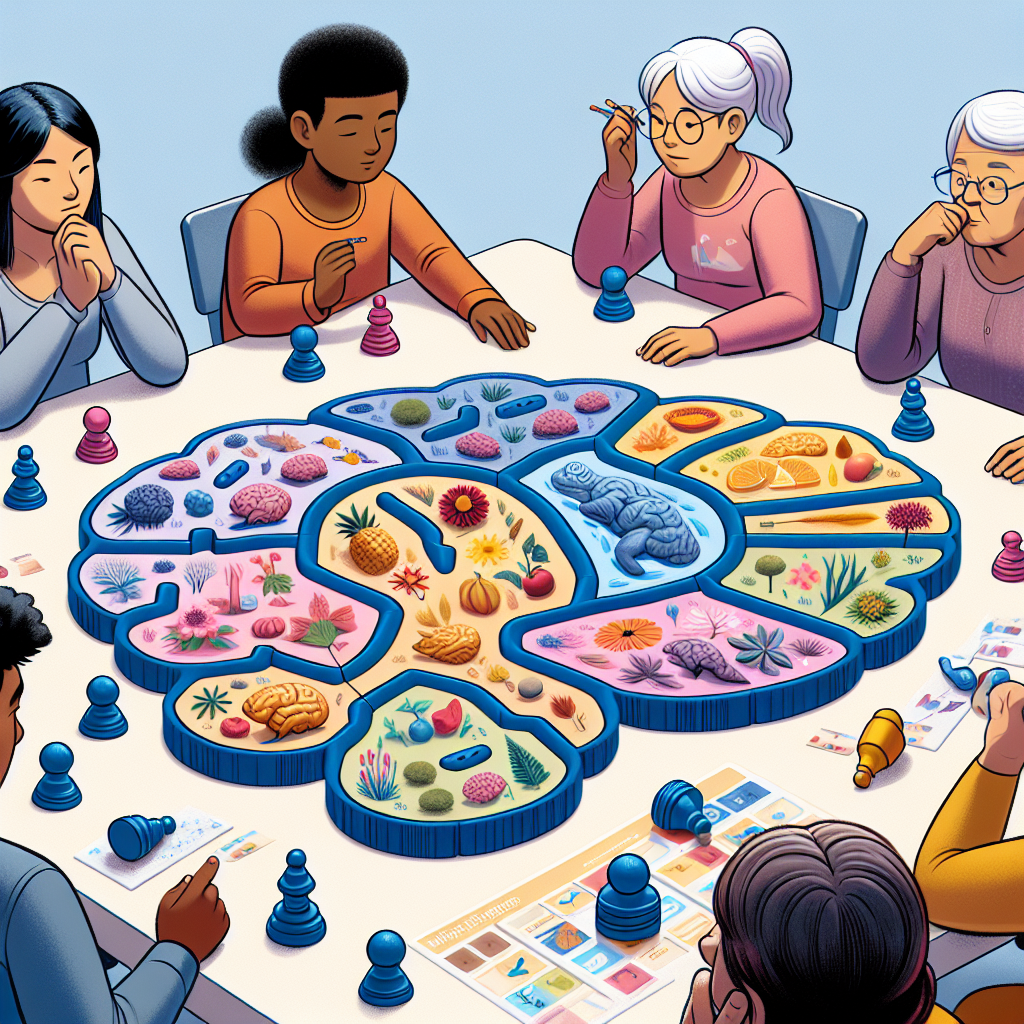
What do board games, neuroscience, brain hacking, and the common senses have in common?
They are all essential elements of the board game WHIFF.
The world of games is often dominated by the visual, whether in electronic or analog format. At the Festival International des Jeux, I had the opportunity to try some games that break this mold. During the Nuits du Off, I was lucky enough to meet Drs. Alice Drew and Alice Vidal and try their party game prototype, WHIFF.
The concept of WHIFF is simple. There are a series of jars on a beautiful wooden carousel, each with a different aroma. The name of the aroma is written on the inside of the lid. To play, the participant selects a jar, places it in a special holder with a light bulb, and chooses a difficulty level:
Easy: the color matches the aroma
Medium: the color does not match the aroma
Hard: the color may or may not match the aroma
Once selected, another player checks the answer and places a color filter before turning on the light. The main player takes the wooden holder and inhales deeply.
If it seems simple, it is because you haven't tried it yet. This game is based on scientific research on how our perception of smell is influenced by visual information, much like the sense of taste. During my experience, I became obsessed with the idea that the yellow color should be banana, which made everything with yellow light smell like banana to me. My best result was with truffle and red light, although I still don't understand why I associated it with garlic. Science is still seeking more concrete answers to explain how we process sensory stimuli.
After playing, I arranged an interview to learn more about the game's development.
The origin of WHIFF
The idea behind WHIFF emerged when Drew and Vidal were finishing their PhDs in neuroscience and began exploring how the brain integrates the senses. Their interest in the world of aromas and flavors made them realize how difficult it is to identify different smells out of context, so they decided to challenge their own perceptions.
At the same time, with the COVID-19 pandemic, many people began to lose their sense of smell, making its impact on quality of life more evident.
There are other games based on aromas, but WHIFF focuses on the disconnect between sight and smell, creating a unique experience where players often rely more on visual information.
WHIFF has also been a finalist at the DAU Festival in Barcelona and was present at the Barcelona Science Festival in 2024, consolidating its link with science.
The future of WHIFF
Although the mechanics are simple, it is easy to imagine this game in homes and social gatherings. During testing, it was evident that it sparked conversation and laughter with each new aroma discovered. It not only fuels competition but also allows players to explore and understand a sense that we often overlook despite its great impact on our lives.
Drs. Drew and Vidal have also developed workshops for corporate events, helping companies and designers understand how the integration of the senses affects our daily experiences.
Currently, WHIFF is published on demand by its creators, but they are looking to expand with publishers and distributors. The board and the scent holder are made from recycled wood, reinforcing its artisanal and eco-friendly aesthetic.
The science behind the game
The foundations of WHIFF are backed by neuroscience. Numerous studies have shown that we process sensory information in an integrated manner rather than isolating each sense. The connection between smell and sight is well documented in experiments with wines, soft drinks, and even meats with unusual colors, demonstrating that visual information can alter our perception of aromas.
This principle opens up multiple applications beyond the culinary field. The integration of the senses can influence the design of spaces, architecture, and even advertising and user experience.
Other smell-based games
WHIFF is available for direct order and will soon include new design and pricing options.
In addition to WHIFF, there are other games that incorporate the sense of smell:
SentoSphere
SentoSphere develops sense-based games for a family and specialized audience. Among its titles, Bacchanales stands out, based on wine tasting. Players bring a bottle of wine and guess its properties to earn points. There is also Voyage Olfactif, where players must describe images using combinations of aromas, adding a level of abstraction and creativity to the mechanics.
Cortex Challenge
This fast-paced puzzle game incorporates different challenges, including aroma and touch cards. Although not entirely focused on smell, it adds an additional sensory dimension that makes it more dynamic.
At Q2BSTUDIO, we believe that technology and innovation can transform the way people interact with the world. As specialists in technological development and services, we are committed to creating unique experiences that, like WHIFF, challenge perception and improve user interaction with their environment.