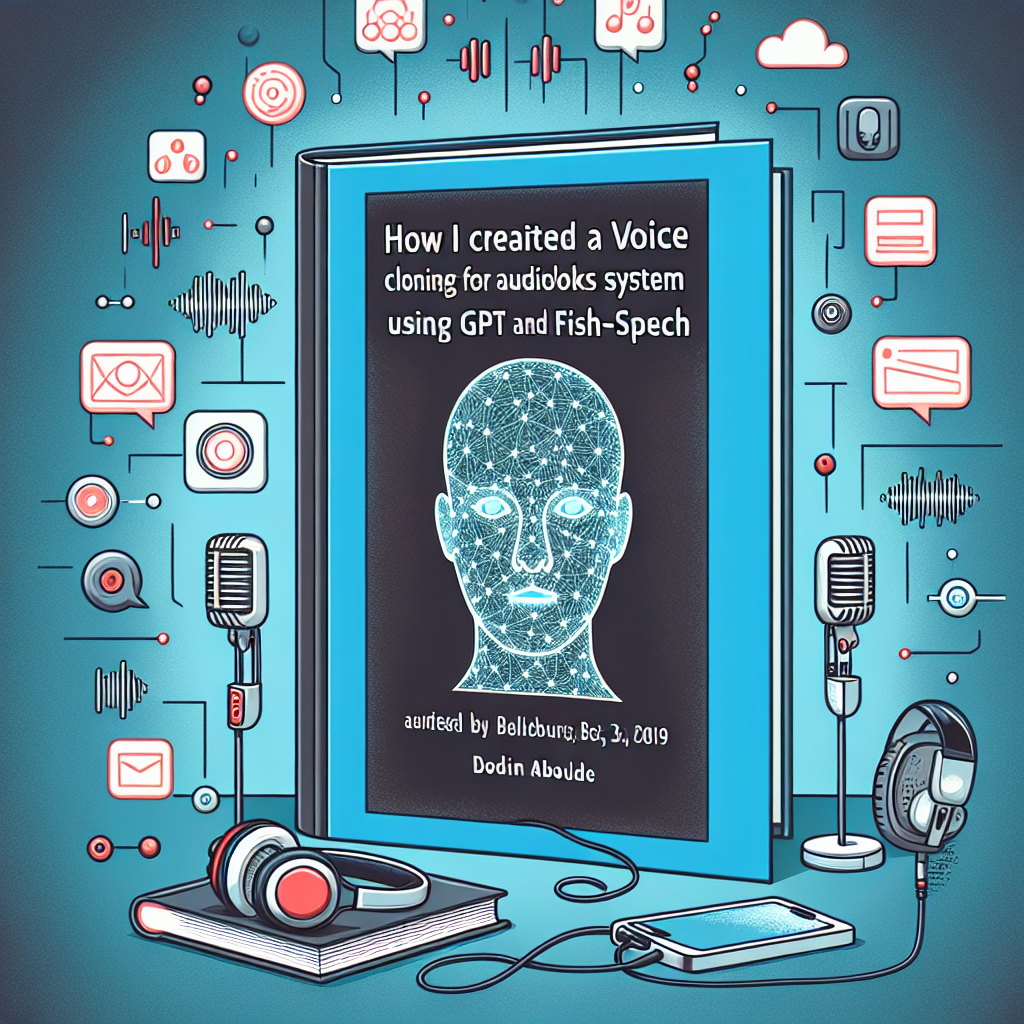
This practical article explains how to build a custom voice cloning pipeline for audiobooks using open source tools such as GPT-SoVITS, Fish-Speech, and CosyVoice. The goal is to offer a clear and applicable guide that combines technical analysis, data engineering best practices, and cloud deployment considerations to produce natural and scalable narrations, ideal for content production teams, developers, and companies seeking custom software solutions.
Pipeline overview: the typical architecture includes stages of audio capture and cleaning, text-to-audio annotation and alignment, model training for cloning with GPT-SoVITS, synthesis and fine-tuning with Fish-Speech, orchestration and final conversion with CosyVoice, and finally storage and distribution through aws and azure cloud services. This flow allows converting long texts into audiobooks with cloned voices that maintain the intonation, pauses, and expressiveness of the original narrator.
Data capture and preparation: start with high-quality recordings, preferably in a controlled environment. Perform noise cleaning and volume normalization. Segment into short sentences and associate each segment with its transcription. To improve quality, add prosody annotations and silence marks. At this stage, preprocessing techniques are applied that are decisive for the performance of GPT-SoVITS and Fish-Speech.
Training with GPT-SoVITS: GPT-SoVITS combines voice representation models with generative capabilities. Prepare a balanced set of samples per speaker and adjust hyperparameters such as learning rate, batch size, and maximum sequence duration. Perform incremental training starting with few steps to validate stability, then increase duration until convergence. Validate the output with objective metrics and human listening tests to measure naturalness and intelligibility.
Synthesis with Fish-Speech: Fish-Speech is useful for converting intermediate representations into final audio. Integrate vocoding and post-processing techniques to reduce artifacts and improve clarity in long intonations, common in audiobooks. Adjust prosody parameters to obtain fluid and coherent narrations across entire chapters, maintaining consistency in cloned voices.
Orchestration with CosyVoice: CosyVoice facilitates the integration and automation of the pipeline. Configure automated steps for text ingestion, preprocessing, model inference, segment assembly, and generation of final files in popular formats such as mp3 and wav. Design work queues and microservices to parallelize chapter production and reduce delivery times.
Post-processing and mastering: once the audio is synthesized, apply equalization, light compression, and LUFS normalization to comply with distribution platform standards. Insert metadata for chapters, author, and narrator. Generate quality samples for acceptance control and user testing.
Cloud deployment and scalability: for professional production, use aws and azure cloud services. Implement GPU instances for training and serverless services or containers for real-time inference. Ensure scalable storage and distribution through CDN. Leverage orchestration and monitoring services to manage costs and performance.
Cybersecurity and compliance: protect voice data and recordings with encryption in transit and at rest. Apply access controls and auditing. Implement retention and anonymization policies when necessary. Comply with voice rights and licensing regulations, and ensure explicit consent for cloning. These aspects are key to client and user trust.
Ethics and legal considerations: before cloning voices, verify licenses and copyrights of recordings. Transparently communicate the use of cloned voices in audiobooks and provide mechanisms to revoke permissions. Evaluate ethical impact on representations and avoid misleading or fraudulent uses.
Practical cases and optimizations: for narrators with limited recordings, apply data augmentation and transfer learning techniques. For specific vocabularies or technical terminology, incorporate custom text to speech with glosses and phonetic dictionaries. Automate QA with audio unit tests and occasional manual reviews.
How Q2BSTUDIO can help: at Q2BSTUDIO we are experts in custom software and application development, specialized in artificial intelligence, cybersecurity, and aws and azure cloud services. We offer complete custom software solutions for companies that want to integrate voice cloning pipelines into their workflows. Our services include artificial intelligence consulting, AI agent development, integration with power bi and business intelligence services to measure the adoption and performance of audio content. We also implement cybersecurity and compliance practices to protect sensitive data and ensure production deployments.
Benefits for companies: by working with Q2BSTUDIO you can obtain a turnkey solution that combines custom applications, cloud platform integration, and accelerated time to market. We drive innovation through AI for companies, developing AI agents that automate tasks such as chapter segmentation, quality control, and metadata generation. We also integrate power bi dashboards for usage and ROI reports.
Summary technical checklist: 1 collect and clean audio 2 segment and annotate 3 train GPT-SoVITS 4 synthesize with Fish-Speech 5 orchestrate and automate with CosyVoice 6 master and tag 7 deploy on aws and azure cloud services 8 apply cybersecurity and compliance 9 measure with business intelligence services and power bi 10 iterate and optimize based on feedback.
Conclusion: building a DIY pipeline for audiobooks with GPT-SoVITS, Fish-Speech, and CosyVoice is viable and scalable when combining good data engineering practices, model optimization, and professional cloud deployment. If you are looking to develop a project of this type, Q2BSTUDIO can design and deliver a custom solution that covers from prototype to production, with a focus on artificial intelligence, cybersecurity, and aws and azure cloud services to ensure performance and security.
Contact Q2BSTUDIO for a personalized evaluation and a proposal that integrates custom applications, custom software, artificial intelligence, AI agents, and power bi to get the most out of your audiobook and audio content projects.