Sequent calculus versus CPS: a compiler's perspective on consumers and evaluation strategies
In this article we explore the practical advantages of using sequent calculus instead of continuation-passing style (CPS) when designing a modern compiler. The focus is on three key areas: destructors, evaluation order, and optimizations related to the eta law, as well as a deep connection with linear logic and strict versus lazy data representations.
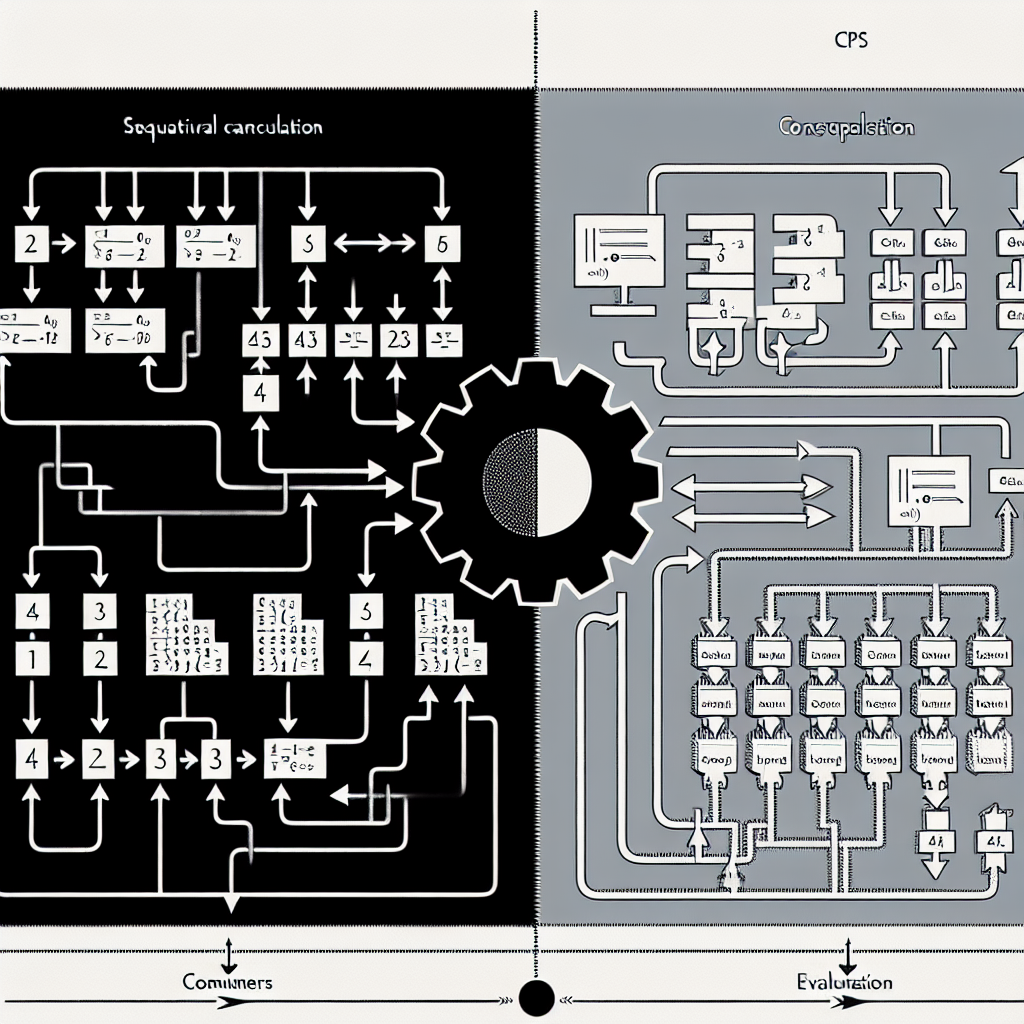
Destructors and consumers: Sequent calculus makes explicit the duality between producers and consumers, allowing destructors to be modeled as first-class objects. This facilitates reasoning about resource release, scope closing, and elimination of temporary values. In CPS, destructors are hidden behind continuations, which complicates optimizations that need to know when and how values are consumed. For compilers that generate efficient and safe code, it is an advantage that consumers are treated directly, as it simplifies liveness analysis and the insertion of destructor calls in the correct order.
Evaluation order: call by value versus call by name: Sequent calculus and polarity techniques offer a declarative way to specify evaluation strategies, allowing switching between call by value and call by name without transforming the entire program into a continuation style. CPS, on the other hand, imposes a calling convention that forces rewriting the control structure to represent the evaluation strategy. In practical terms, this means less noise in transformations and greater opportunity to apply local optimizations without introducing continuation overhead.
Eta optimizations and program equivalences: The eta law and its variants are fundamental for simplifying functional programs and eliminating unnecessary wrappers. In the sequent calculus framework, eta-like equivalences are naturally expressed as rewriting rules between producers and consumers, which facilitates applying semantically safe optimizations. In CPS, these equivalences are sometimes lost or require additional simplification passes because continuations generate intermediate structures that hide the original form of the term.
Connection with linear logic and strict versus lazy representations: Linear logic offers a language for reasoning about resource usage. From the compiler's perspective, this translates into the ability to choose strict or lazy representations for data according to their consumption pattern. For example, a pair can be treated as a linear tensor if its components are consumed exactly once, or as a non-linear product if they can be shared. This distinction allows language and compiler designers to introduce storage and evaluation strategies that reduce copies, improve locality, and optimize memory management.
Algebraic types and pairs in functional languages: Under resource-aware logic, a pair is not a single universal notion but adopts different semantics depending on the consumption context. Compilers that incorporate these principles can generate code that chooses strict representations in cases where evaluation is immediate and lazy ones when there is a possibility of avoiding work. Sequent calculus facilitates this reasoning by making consumers explicit, plugging usage rules directly into the evaluation flow.
Implications for compiler and runtime design: In practical terms, adopting a sequent calculus-based approach can translate into fewer transformation passes, code generation closer to the program's semantic intent, and better opportunities for aggressive optimizations related to destructors, inlining, and wrapper elimination. It also improves integration with effect analysis and garbage collection strategies or deterministic resource release.
Q2BSTUDIO specialists in custom solutions and cutting-edge technologies: At Q2BSTUDIO we are a software and custom application development company with experience in integrating advanced compilation concepts, artificial intelligence, and security. We offer custom software services, custom applications, and artificial intelligence solutions designed for companies that need personalized AI agents, AI for businesses, and integration with analytics platforms such as Power BI. Our team applies good engineering practices and theoretical knowledge to build transformation and optimization pipelines that improve performance and security.
Featured services and competencies: Q2BSTUDIO provides cybersecurity services, AWS and Azure cloud services, and business intelligence services. We develop artificial intelligence solutions and AI agents that integrate with existing architectures and provide advanced automation and analytics capabilities. If your project requires custom software or custom applications oriented toward high performance, resource management, and regulatory compliance, we can help from technical design to production deployment.
How these topics connect with real solutions: In R&D and software engineering projects, applying principles such as those of sequent calculus allows building runtimes and middleware components that manage resources with precision, improve latency, and reduce operational cost in cloud environments. In combination with cybersecurity practices and data analytics through Power BI and business intelligence services, a complete solution is obtained that covers everything from compiler-level optimization to business value delivery.
Conclusion: Sequent calculus provides clear advantages over CPS when the goal is to reason about consumers, destructors, and evaluation order in a direct and composable way. By connecting these principles with linear logic, compilers can make more informed decisions about strict and lazy data representations. At Q2BSTUDIO we apply this type of approach in custom software developments and artificial intelligence initiatives and AWS and Azure cloud services to offer secure, scalable, and optimized solutions that include cybersecurity, AI agents, and business intelligence with Power BI.