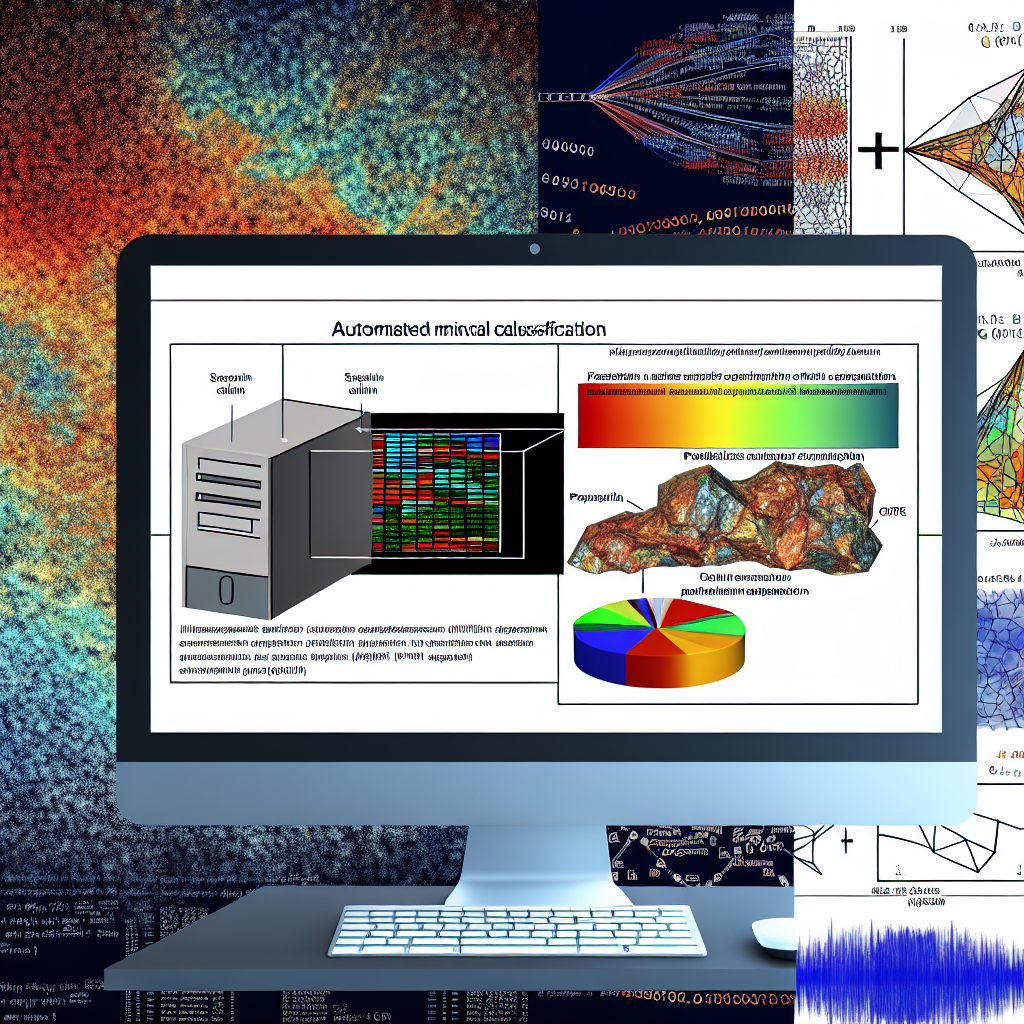
Automated mineralogical classification via hyperspectral data fusion and Bayesian inference applied to carbonaceous chondrites
Abstract This work presents an automated system for mineralogical identification in polished thin sections of carbonaceous chondrites using hyperspectral imaging at the microscopic scale. The proposal combines hyperspectral data fusion, Bayesian analysis, and deep learning to achieve fast and accurate classification of key mineral phases such as pyroxenes, olivine, phyllosilicates, sulfides, and carbonates. In controlled tests, the system achieves an overall accuracy of approximately 98.2 percent and processing times of around 15 seconds per image, surpassing expert manual evaluation in consistency and speed.
Introduction Carbonaceous chondrites preserve fundamental information about the early formation processes of the solar system. Detailed mineralogical identification is essential but traditionally laborious and subject to human variability. Hyperspectral imaging offers rich spectral signatures that, combined with advanced processing techniques and probabilistic models, allow automating this analysis and increasing its reproducibility and scale.
General methodology The system consists of four main modules: data acquisition and preprocessing, hyperspectral fusion, Bayesian classification, and validation with iterative refinement. It also integrates texture extraction with pre-trained convolutional neural networks and a reinforcement learning loop to optimize parameters according to errors detected in validation.
Acquisition and preprocessing Hyperspectral images are captured in the 350 to 1000 nm range with an approximate spectral resolution of 5 nm on polished thin sections of representative meteorites such as Allende, Murchison, and Orgueil. Preprocessing includes dark current correction, spectral normalization, spatial registration, and masking of non-mineral regions to reduce noise.
Hyperspectral data fusion Each per-pixel spectral curve is organized into a data matrix and dimensionally reduced using Principal Component Analysis, retaining the first six principal components that explain more than 95 percent of the variance. This condensed representation attenuates spectral overlap and makes classification manageable in a low-dimensional space.
Bayesian classification and texture extraction In the six-dimensional space, each mineral is modeled using a multivariate Gaussian distribution whose mean and covariance matrix are estimated from labeled data. Applying Bayes' theorem, the posterior probability of each mineral given the fused feature vector is calculated, and the class with the highest probability is assigned. Simultaneously, a pre-trained convolutional neural network such as ResNet50 extracts textural features that are concatenated with the principal components to enrich the input information of the Bayesian classifier.
Validation and refinement Evaluation is performed with an independent test set, and a confusion matrix is used to analyze errors by mineral phase. A reinforcement learning loop iteratively adjusts the parameters of the Bayesian classifier and performs fine-tuning of the CNN based on error signals, improving robustness against variations in sample preparation and instrumental conditions.
Experimental design The study used a set of 100 hyperspectral images divided into 70 percent for training, 15 percent for validation, and 15 percent for testing. Ground truth was established by petrologists using optical microscopy and electron microprobe analysis. Metrics included per-pixel classification accuracy, F1 scores per mineral, and processing time per image. A blind trial with human experts was conducted as a baseline.
Results The system achieved an overall accuracy of approximately 98.2 percent compared to an average human performance close to 92 percent under the same test conditions. Average processing times were on the order of 15 seconds per image. Reported F1 scores were high for pyroxene, olivine, and phyllosilicates, and slightly lower for sulfide and carbonates, reflecting areas of greater spectral overlap.
Discussion The combination of spectral fusion, Bayesian inference, and texture extraction via CNN showed clear synergies: PCA reduces noise and dimensionality, the CNN captures spatial patterns that pure spectral analysis does not detect, and Bayesian classification provides an interpretable probabilistic framework. Current limitations include the classification of very fine-grained minerals with practically indistinguishable signatures and the dependence on good representativeness in the training set. Future improvements may incorporate polarization information, data augmentation techniques using generative models, and sensors with higher spectral or spatial resolution.
Practical applications and commercialization This system is applicable to meteorite laboratories, asteroid sample return missions, and remote processing of mineral collections. Commercially, it can be integrated as custom software for research centers and companies requiring fast and scalable mineralogical analysis. Q2BSTUDIO, a company specialized in custom software development and custom applications, can adapt and implement solutions based on this technology, integrating artificial intelligence services, cybersecurity, AWS and Azure cloud services, and business intelligence services. We also offer AI for businesses, AI agents, and Power BI dashboards for result exploitation and visualization.
Conclusion The system demonstrates that automating mineralogical classification through hyperspectral fusion, Bayesian models, and deep learning is practical, accurate, and scalable. Implemented as a commercial solution by technology companies such as Q2BSTUDIO, it can accelerate meteoritics research, support space missions, and offer added value to industrial and materials sectors through custom software, artificial intelligence, cybersecurity, cloud services, and business analytics.
Keywords custom applications, custom software, artificial intelligence, cybersecurity, AWS and Azure cloud services, business intelligence services, AI for businesses, AI agents, Power BI