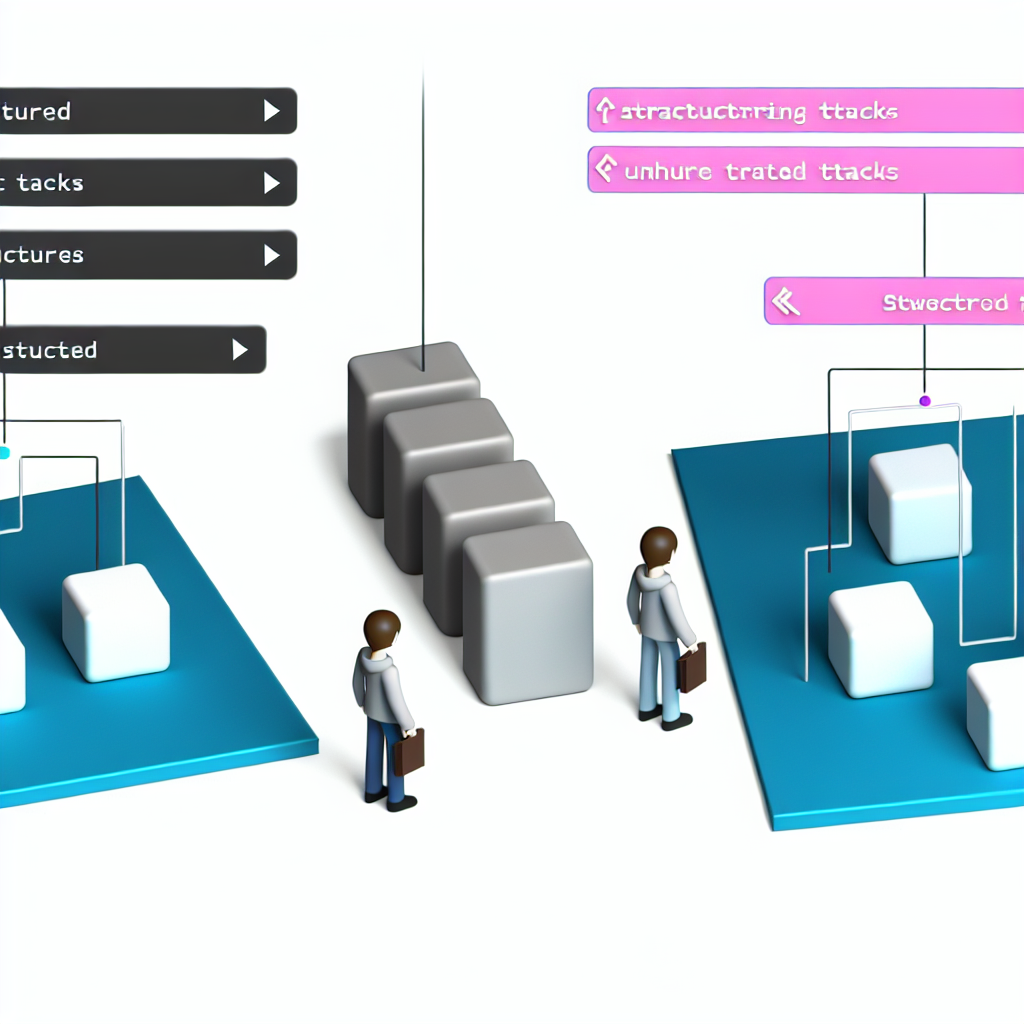
Task in Swift A Task in Swift is a container for code that runs independently without blocking the application interface. While one task downloads data from the internet, another can update the screen simultaneously, keeping the app responsive. Tasks allow multiple operations to occur at the same time instead of waiting for each one to finish sequentially.
Structured tasks Structured tasks work like a family tree where parent tasks automatically manage their children. They are created with async let or TaskGroup and inherit context from the parent, and must complete their work before the parent can finish. When the parent task ends, its children also end, preventing processes from accidentally continuing to run. This is especially useful in custom application projects and custom software where control and robustness in concurrency are needed.
Unstructured tasks Unstructured tasks run independently, like separate applications on a device. They are created with Task { } or Task.detached { } and manage their own lifecycle, and can continue running even after the code that started them has finished. This independence is ideal for long-running background operations, such as saving user data after a UI event, and fits well with artificial intelligence solutions, AI agents, and telemetry processes in enterprise systems.
Key differences Lifecycle management Structured tasks automatically end when the parent scope finishes, avoiding orphans. Unstructured tasks continue independently and require explicit handling to cancel or monitor them.
Context inheritance Structured tasks inherit local task values, priority, and cancellation from the parent. Unstructured tasks created with Task { } inherit part of the context such as actor isolation, while Task.detached { } starts completely clean with no inherited context.
Cancellation propagation When a structured parent task is cancelled, all child tasks are automatically cancelled. In unstructured tasks, it is necessary to check cancellation manually and handle it appropriately.
Scope limits Structured tasks cannot escape their defining scope; the parent waits for all children to complete. Unstructured tasks can outlive the scope that created them, offering flexibility for long-running operations, such as analytics processes and AWS and Azure cloud services that require continuity.
Example 1 Structured task with TaskGroup func fetchMultipleUserProfiles() async throws -> [UserProfile] { return try await withThrowingTaskGroup(of: UserProfile.self) { group in let userIDs = [1, 2, 3, 4, 5] for id in userIDs { group.addTask { return try await fetchUserProfile(id: id) } } var profiles: [UserProfile] = [] for try await profile in group { profiles.append(profile) } return profiles } } In this example, the TaskGroup creates a structured environment where all child tasks are managed automatically. If the parent function is cancelled, all profile fetching operations are cancelled. The function cannot return until all children complete or throw an error.
Example 2 Unstructured task for independent operation class ViewController: UIViewController { var analyticsTask: Task<Void, Never>? @IBAction func buttonTapped(_ sender: UIButton) { analyticsTask = Task { await logUserInteraction(action: button_tap) if Task.isCancelled { return } await uploadAnalytics() } updateUI() } deinit { analyticsTask?.cancel() } } This unstructured task manages usage analytics independently of the button handler scope. It continues after the action method returns, demonstrating the flexibility of unstructured tasks. Manual cancellation in deinit ensures proper cleanup.
Conclusion and Q2BSTUDIO services The choice between structured and unstructured tasks depends on the requirements of each operation. Structured tasks are ideal when the work has clear boundaries and parent-child relationships, providing automatic resource management and cancellation propagation. Unstructured tasks offer flexibility for independent operations that must transcend scope limits, although they require manual management. At Q2BSTUDIO we offer custom software development services and custom application development, integrating artificial intelligence and AI solutions for businesses, AI agents, and cybersecurity. We also provide AWS and Azure cloud services and business intelligence services including Power BI to maximize the value of data. If you need a robust concurrent architecture for your application or an integrated artificial intelligence strategy, Q2BSTUDIO can help with consulting, design, and execution of custom projects combining expertise in custom software, custom applications, artificial intelligence, cybersecurity, AWS and Azure cloud services, business intelligence services, AI agents, and Power BI.