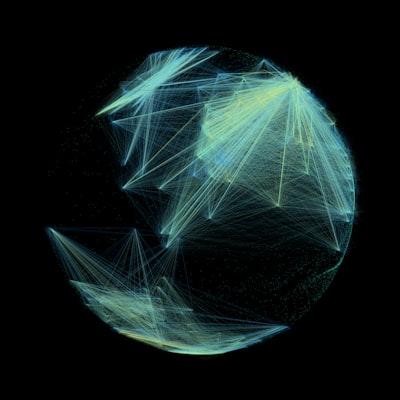
The recent publication of a paper titled 'ShellFlow: Generative Model Learns the Standard Model from LHC Data' has captured the attention of both the scientific and technological communities. It describes how a transformer-based model conditioned by Riemannian flows, trained on a single set of 10^9 real proton-proton collision events, reproduces fundamental properties of the Standard Model: from dilepton resonances (J/ψ, Υ, Z) to the W and top quark masses, including the Weinberg angle. Remarkably, the model receives no information beyond the on-shell condition and the invariant mass formula; everything else is learned autonomously. This milestone opens a new paradigm: artificial intelligence not only assists in data analysis but begins to discover underlying physical laws by itself.
Behind ShellFlow lies sophisticated technical design. The model employs a Riemannian flow matching mechanism, generating each particle on its on-shell manifold. This allows the generator to capture inter-particle correlations that were never included in an explicit loss function. The result is a generative representation covering five decades of invariant mass, from the sub-GeV range to the TeV continuum, something no single Monte Carlo generator achieves. For software development companies, this represents an extreme use case: the ability to train generative models on massive, noisy, highly structured data and extract physical knowledge directly. The implications for fields such as bioinformatics, materials simulation, or financial modeling are enormous.
At Q2BSTUDIO, as a software and technology development company, we see ShellFlow as a perfect example of how generative AI can be integrated into business environments. The model not only requires powerful computing infrastructure — typically on AWS or Azure clouds to handle billions of data points — but also a custom AI design tailored to specific domains. Creating custom software applications that implement similar flow matching or transformer architectures can revolutionize sectors where reliable synthetic data generation is critical, such as pharmaceuticals or automotive. Furthermore, cybersecurity plays an essential role: LHC collision data is public, but in corporate environments, sensitive data requires protection. Q2BSTUDIO offers cybersecurity services to ensure that both training and inference of these models are carried out securely, complying with regulations such as GDPR or HIPAA.
Another relevant aspect is the visualization and analysis of results. A generative model like ShellFlow produces enormous volumes of simulated particle data. To extract value from it, Business Intelligence tools like Power BI are needed, allowing scientists and engineers to explore distributions, correlations, and anomalies interactively. Q2BSTUDIO integrates cloud services AWS/Azure with BI platforms to create real-time dashboards, facilitating data-driven decision making. The combination of generative AI, scalable cloud, and BI turns ShellFlow into a case study for any company aiming to move towards intelligent automation of research and development processes.
Finally, the emergence of autonomous AI agents capable of refining generative models without human intervention is a natural evolution. ShellFlow already shows a degree of autonomy by learning physics without explicit supervision. In the near future, we may see agents that tune hyperparameters, select architectures, and validate results in real time, all on elastic cloud infrastructures. Q2BSTUDIO is ready to help organizations design and implement these AI agents, as well as build custom applications that integrate generative models, cybersecurity, and BI. ShellFlow is not just an academic achievement; it is a demonstration that AI can extract fundamental knowledge directly from data, and that is a business opportunity for those who know how to seize it.