When traveling for work, comfort and efficiency often become hard-to-reach luxuries. A laptop stand is, in my experience, the accessory that makes the difference between a productive day and one full of physical and technical discomfort. It is not just about raising the screen a few inches: it is about transforming any improvised space - a hotel desk, an airport counter, or a noisy cafe - into an ergonomic and functional workstation. Over more than a decade of teleworking and frequent trips, I have found that a well-designed stand reduces neck strain, improves laptop ventilation, and, surprisingly, optimizes equipment performance.
From a technical perspective, a laptop resting directly on a flat surface has restricted airflow. Modern models, especially those designed for gaming or mobile workstations, dissipate heat through the base and sides. By elevating it, a natural convection current is created that keeps components cooler, resulting in less thermal throttling and therefore better sustained performance in demanding tasks such as video editing, 3D modeling, or running multiple virtual machines. For a professional using data analysis tools like Power BI or cloud services such as AWS or Azure, every CPU cycle counts. An overheated laptop not only reduces processing speed but also shortens the lifespan of internal components.
The business scope does not escape this reality. When a company deploys remote teams, investing in ergonomic accessories ceases to be a minor expense and becomes a strategic line item. Employees who work with chronic physical discomfort have up to 20% lower productivity and higher absenteeism rates. Therefore, equipping frequent travelers with a portable stand, along with a compact external keyboard and a vertical mouse, can significantly reduce musculoskeletal problems. Moreover, from a cybersecurity standpoint, working in public spaces with the laptop elevated and without a firm base can lead to carelessness - such as leaving the device unattended or connecting to unsecured wifi networks - that compromises corporate data. A proper posture also helps maintain attention and thus be more aware of the surroundings.
In this context, Q2BSTUDIO, as a software development and technology company, understands that mobility should not sacrifice work quality. Therefore, beyond hardware, they offer solutions that enable teams to operate efficiently from anywhere. For example, their cloud AWS/Azure services help companies migrate their applications to the cloud, ensuring data is secure and accessible from any device, even from a laptop on an improvised stand in a waiting room. Likewise, the development of custom software applications allows creating tools tailored to each organization's specific needs, from project management platforms to Business Intelligence (BI) systems with Power BI that update in real time from the cloud.
Artificial intelligence (AI) also plays a growing role in optimizing remote work. The AI agents developed by Q2BSTUDIO can automate repetitive tasks, such as email sorting or report generation, freeing up the professional's time to focus on what truly matters. These agents, combined with a robust cloud infrastructure on AWS or Azure, work seamlessly even when the user is on the move, as long as the laptop maintains an adequate temperature to avoid performance drops. Of course, cybersecurity is a fundamental pillar: when accessing the cloud from public networks, having solutions like corporate VPNs and multi-factor authentication (MFA) is essential, and Q2BSTUDIO offers cybersecurity and pentesting services to identify vulnerabilities before they are exploited.
Another relevant technical aspect is thermal management in high-performance laptops. Modern chips, such as 14th-generation Intel Core or AMD Ryzen 7000, can reach temperatures up to 100 °C before throttling. A stand that allows optimal airflow can keep those chips below 85 °C under maximum loads, translating into sustained performance between 5% and 10% higher. For a developer compiling code or an analyst processing large volumes of data with BI tools, that difference can mean hours saved per week. Additionally, the laptop fans spin at lower speeds when temperatures are low, reducing noise and making work in quiet environments - like a library or a train - much more pleasant.
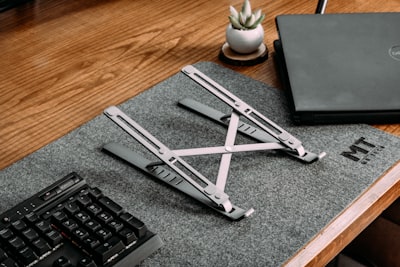
Choosing the right stand also deserves technical analysis. There are foldable aluminum models weighing less than 300 grams that support laptops up to 16 inches, with adjustable tilt angles to find the perfect angle to avoid glare and reduce eye strain. Some even incorporate additional USB fans, but in my experience open stands that allow air to pass underneath are sufficient. What is essential is robustness: a stand that wobbles with every keystroke generates frustration and can cause the laptop to fall. That is why I recommend investing in a quality model, even though there are budget options for less than 30 euros. In the end, the cost is amortized by the improvement in health and productivity.
From a business perspective, adopting laptop stands should be part of the remote equipment policy. Many companies already provide their employees with ergonomic kits that include a stand, keyboard, and mouse. But if these are also integrated with device management platforms (MDM) and cloud computing solutions, such as those offered by Q2BSTUDIO, a coherent ecosystem is created. For example, an employee traveling to a trade fair can connect to the corporate network via a VPN and access a virtual desktop hosted on AWS, while the local laptop only handles the interface. In that scenario, a lightweight stand allows maintaining an ergonomic posture during long days of presentations and virtual meetings.
Artificial intelligence and autonomous agents are also transforming how we manage business trips. Companies like Q2BSTUDIO develop AI agents that can book flights, hotels, and meeting rooms, as well as sync calendars and remind of important documents. All of this relies on scalable and secure cloud infrastructures. And when the user needs to work offline, custom applications can automatically sync as soon as they regain connection, minimizing data loss. In this context, having a laptop that runs at full performance thanks to a ventilated stand is a basic requirement.
In conclusion, the laptop stand is not a superfluous accessory but an essential tool for any professional who travels frequently. It improves ergonomics, extends equipment life, optimizes performance, and ultimately contributes to healthier and more productive work. When combined with cloud services, custom software development, artificial intelligence, and cybersecurity, a solid and reliable remote work infrastructure is built. So, the next time you pack for a business trip, do not forget to include your stand. Your back - and your productivity - will thank you.