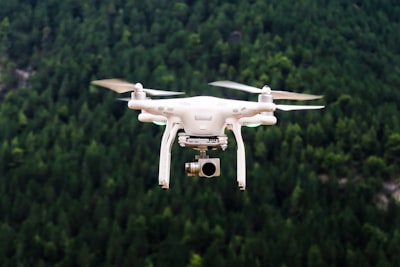
The advancement of artificial intelligence systems applied to aerial robotics is reaching levels that only a few years ago seemed like science fiction. The ability of a drone to understand complex questions, plan its movements, and execute precise actions in real environments represents a qualitative leap in intelligent automation. In this context, a new benchmark has emerged: ActiveFly-Bench, a testing platform designed to bridge the gap between cyberspace reasoning and physical-world interaction. This platform structures active perception into three hierarchical levels — Aerial Embodied Question Answering (Air-EQA), Observation Behavior Planning (OBP), and Fine-grained Language-guided UAV Control (FLUC) — connecting high-level task understanding with low-level control.
ActiveFly-Bench is not just a dataset; it is an evaluation ecosystem that integrates simulated and real environments to train and measure aerial agents. The ActiveFly agent, developed as part of this initiative, combines visual-linguistic reasoning with precision control, deployed on physical platforms. Experiments with vision-language models (VLM) and vision-language-action models (VLA) reveal that current agents still face significant difficulties in behavior planning, viewpoint adjustment, and robust task completion.
This challenge is not trivial: from infrastructure inspection to emergency response, a drone that can interpret complex commands such as 'examine the crack on the south facade' or 'follow that path while avoiding obstacles' needs to integrate perception, reasoning, and control in a closed loop. We are talking about a leap from basic autonomous systems to true embodied aerial intelligence. This is where the software industry plays a crucial role, and companies like Q2BSTUDIO are positioned to lead the transformation.
The relationship between this kind of cutting-edge research and the development of custom software is direct. Computer vision systems, multimodal data fusion, and language-robot interaction require a solid and personalized software architecture. It is not about integrating a generic API; each use case — precision agriculture, logistics, surveillance — demands an adapted solution. Q2BSTUDIO understands that the key lies in building abstraction layers that allow AI agents to interpret commands, manage sensors, and execute actions without latency.
One of the technological pillars that makes ActiveFly-Bench possible is artificial intelligence, especially in its autonomous agent variant. Modern AI agents are no longer simple voice assistants; they become decision cores capable of planning routes, recognizing objects, and adapting to changing conditions. Q2BSTUDIO incorporates these capabilities into automation projects, where AI not only processes information but also acts on the environment. The combination of large language models (LLMs) and vision models allows a drone to understand 'avoid the area marked in red' and generate safe trajectories in real time.
Fine-grained language-guided control (FLUC) demands extremely fast and reliable communication between the system's brain and the actuators. This is where cloud infrastructures from AWS and Azure come into play. Q2BSTUDIO deploys cloud AWS/Azure solutions that guarantee the cloud computing needed to train and run complex models, as well as edge computing to reduce latency. Drones cannot rely exclusively on the cloud in remote environments; hybrid architecture is essential. The company offers consulting to design systems that balance local and remote processing.
We cannot ignore cybersecurity. An autonomous drone operating in public spaces is a potential attack vector. Communication between the agent and the base station, sensor data, and flight commands must be protected. Q2BSTUDIO integrates cybersecurity at every stage of development, from embedded system pentesting to telemetry encryption. Trust in critical systems is built with robust protocols and continuous audits.
Finally, the ability to analyze the behavior of these agents requires business intelligence tools. Data collected by drones — images, coordinates, performance metrics — is massive and complex. Q2BSTUDIO uses BI/Power BI to transform that data into interactive dashboards that allow operations teams to make informed decisions. For example, visualizing inspection coverage, detecting failure patterns, or optimizing flight routes.
ActiveFly-Bench sets a new standard for embodied aerial intelligence, but its success will depend on the industry's ability to translate laboratory advances into operational applications. Companies like Q2BSTUDIO, with expertise in custom software development, AI, cloud, and cybersecurity, are called to be the bridge between academic research and commercial deployment. The question is no longer whether drones will understand human language, but how we will integrate that understanding into robust, secure, and scalable systems. ActiveFly-Bench shows that the path is promising, but there is still work ahead: behavior planning, viewpoint adjustment, and fine-grained control are challenges that require top-level engineering solutions. At Q2BSTUDIO, we are ready to tackle them.