QANTIS: POMDP belief updates on IBM Heron. Autonomous systems operating in the real world rarely have a complete view of their environment. A drone, a warehouse robot or a delivery vehicle receives noisy sensors, partial readings and messages that may arrive late. Instead of reasoning about the exact state, these systems reason about a belief: a probability distribution that summarizes everything the agent knows. Managing that belief is not an implementation detail; it is the foundation of safety and performance.
The tiger problem, a classic in planning under uncertainty, illustrates this difficulty perfectly. There are two doors, behind one there is a tiger and behind the other a reward. The agent can listen to obtain clues, but hearing is not reliable. If it opens the door with the tiger, the cost is high; if it opens the correct one, it obtains a reward. A POMDP models this situation with states, actions, observations and rewards. The initial belief assigns the same probability to both doors; each new observation adjusts it. When evidence is very rare or very weak, this adjustment becomes numerically unstable and the final decision can change because of a small numerical error.
QANTIS starts from a practical observation: the quantum processor can be treated as a belief-update service. It does not need to solve the whole POMDP. It receives a prior, an observation model and a rare-evidence signal; it estimates the likelihood term; and it returns a classical posterior to a planner. This approach makes sense because Bayesian inference with low-probability events is one of the points where classical methods suffer most. The accuracy of the update depends on estimating the probability of an observation that almost never happens. There, quantum amplitude estimation can provide lower variance than classical sampling.
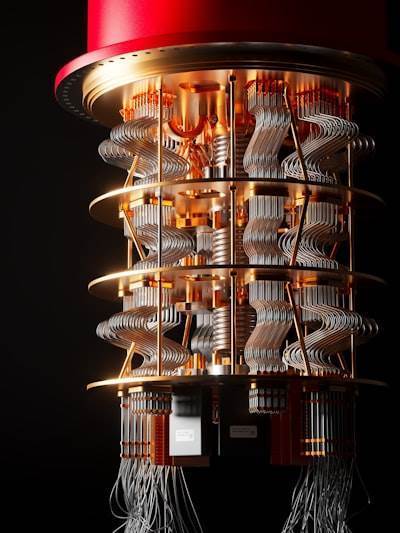
The study behind the title runs on IBM Heron, IBM's current hardware processor, and is not presented as a demonstration of speed superiority. What it seeks is to delimit an operating envelope: under what conditions the posterior returned by the hardware remains faithful to the exact Bayesian posterior and, more importantly, under what conditions it does not change the immediate action selected by the planner. This is a robustness question, not a performance question. It is the right question before integrating quantum computing into a real decision loop.
To evaluate fidelity, the authors compare three amplification modes. The first does not amplify and uses the raw output of the circuit. The second applies a guarded Grover amplification, which seeks to increase the probability of the states of interest. The third uses fixed-point amplification at all steps of the horizon. The difference between the last two is crucial: Grover amplification can move the final distribution away from the correct one if applied for too long, while fixed-point amplification corrects that bias. In the primary runs of eight and twelve steps, and in the twenty- and thirty-two-step controls, the quantum and exact posteriors select the same immediate action. That means the residual error is not harmless; it is irrelevant to the decision.
The second technical piece is boundary-aware amplitude estimation, called BIQAE. When the probability to be estimated is very close to zero or very close to one, standard quantum amplitude estimators lose precision because the likelihood function flattens. BIQAE explicitly handles these cases and allows a sweep of the sample-complexity envelope for one-in-a-million evidence. This endpoint calibration is exactly what an autonomous system needs: rare events are the most dangerous and the ones that distort the posterior most if not estimated well.
The engineering lesson left by QANTIS is that quantum computing cannot be treated as a black box. The final result depends on the construction of the oracle, the amplification strategy and the hardware calibration. An apparently reasonable posterior can be badly calibrated in its tails and, in a POMDP, that error appears much later as an unexpected action. Therefore, any AI project with quantum components must include a set of fidelity tests: compare the quantum posterior with the classical one, measure the maximum error, and verify that the chosen action does not change across a representative set of trajectories.
At Q2BSTUDIO, as a software and technology development company, we closely follow this trend. Integrating quantum solutions into production environments is not an academic exercise; it is a software architecture problem. We need interfaces that consume the posterior, adapters that translate the observation model into circuits, and monitoring layers that alert when the error leaves the envelope. That work requires experience in classical applications and in the logic of hybrid computing.
For example, a logistics company that uses AI agents to plan routes can benefit from a stable belief update when observations are scarce. To integrate that service into production, sending quantum circuits is not enough: it is necessary to build custom software that connects the classical planner with the quantum backend, deploy the microservices on AWS/Azure cloud, monitor the deviation with BI/Power BI dashboards and protect access through cybersecurity. Furthermore, the whole cycle can be orchestrated with Artificial Intelligence agents that decide when to invoke the quantum service and when to keep the classical Bayesian estimate.
This combination is not futuristic. Today's AI agents already make decisions in logistics, financial and healthcare systems. What is missing is that those decisions are transparent and calibrated. An agent that never expresses uncertainty is dangerous. POMDPs provide the language to talk about beliefs, and services like QANTIS suggest that quantum hardware can stabilize that language in rare-event scenarios. The next step will be to integrate this logic into automation platforms that today use rules or language models.
In short, QANTIS does not promise an immediate revolution in autonomy; it promises a measurable way to know when a quantum processor is useful for Bayesian inference. The IBM Heron use case defines an operating window, not an overall victory. That prudence is valuable: it allows companies to plan investments, engineering teams and validation processes. Whoever starts building the software, security, cloud and analytics infrastructure around these services now will be better positioned when quantum hardware reaches maturity. The artificial intelligence of the future will not be only classical nor only quantum; it will be a mixture controlled by good data contracts and rigorous engineering.