Is digitizing my company suitable for startups and large enterprises? The answer is yes, with important nuances. Digitization is, above all, an enterprise architecture decision: which business events are recorded, with what level of detail, and how quickly they must be available for decision-making. It is not about copying what other organizations do, but about building a digital operating model that responds to the company's actual reality, available resources, and growth objectives. A three-person startup and a multinational with fifty offices can both benefit, provided they define an approach aligned with their maturity.
For startups, the main value of digitization lies in learning speed. When a young company automates lead capture, the sales funnel, or incident management, it can test product and market changes without operational tasks consuming all the team's time. Moreover, an early and well-designed digitization effort prevents technical debt from piling up. The goal is not to install dozens of tools, but to keep a simple, well-connected core of processes.
Large companies face a more complex scenario. They usually have legacy systems, departments with different work cultures, industry regulations, and a scale that multiplies any inefficiency. In this context, digitizing means breaking silos, harmonizing data, and establishing clear governance rules. Without an integration layer and quality standards, digitization can amplify chaos instead of reducing it.
Digital maturity should therefore not be measured by the number of tools adopted, but by the coherence among processes, applications, and data. An organization is truly digitized when a single data item can travel automatically from its origin to a business decision, passing through quality controls, validations, and audit trails. This vision requires thinking in terms of APIs, events, connectors, and workflows, not in software islands.
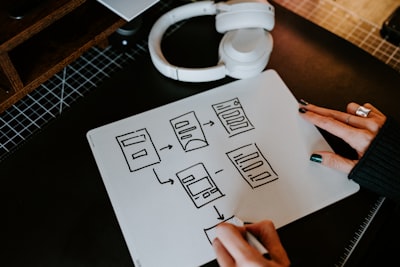
The recommended starting point is always a concrete process. Choosing a high-volume, high-impact flow, such as order management, expense approvals, or customer support, enables fast learning and visible results. That first digitization should be used to validate the methodology before expanding it to the rest of the organization. Process modeling techniques, such as BPMN or value stream maps, help identify bottlenecks and define the indicators that will determine success.
Once the process is identified, technology must be selected according to flexibility and evolution criteria. Standard solutions cover generic needs, but they almost always force the business to adapt to the tool. The more specific the competitive advantage, the more sense it makes to choose custom software that reflects the company's business rules, roles, and exceptions.
In this context, an approach based on custom software offers clear advantages: the software grows with the company, adjusts to changes in the business model, and does not drag along unnecessary features. Furthermore, with code and architecture under control, the organization can better prioritize evolution and protect its intellectual property.
Integration is another pillar. Data generated in a CRM must coexist with an ERP, billing tools, customer portals, and BI platforms. To achieve this, services must be exposed through APIs, asynchronous events handled via message queues, and a persistence layer maintained to guarantee consistency. Without that architecture, every automation becomes a new point of friction.
The infrastructure supporting digitization has also changed. Migrating to AWS/Azure cloud makes it possible to adjust resources to demand, shorten deployment times, and reduce the fixed cost of data centers. For a startup, this translates into a low entry barrier; for a large company, into elasticity and operational continuity. However, a cloud migration must be accompanied by security policies, resource tagging, and identity management.
Having data available in the cloud is not enough if it is not transformed into actionable information. This is where Business Intelligence (BI) appears, with tools such as Power BI, to visualize sales, operations, and finance indicators. A good dashboard enables teams to detect trends, compare business units, and respond with evidence. The key is that data reaches the dashboard clean and with a shared semantic model.
At this point, artificial intelligence multiplies the impact of digitization. AI agents can be trained to classify requests, draft responses, extract data from documents, or detect anomalies in time series. There are also models that help predict demand, estimate default risk, or personalize recommendations. Applied to digital processes, these capabilities reduce repetitive tasks and free human talent for higher-value activities.
However, every new connected service and every digitized piece of data expands the attack surface. Cybersecurity must be part of the design from day one: user authentication, permission management, encryption in transit and at rest, access logging, and penetration testing. A security breach affects not only operations but also the trust of customers and investors.
This combination of processes, data, integration, cloud, and artificial intelligence requires a technology partner with an architectural vision. Q2BSTUDIO, a software and technology development company, works on digitization projects with organizations of different sizes. Its practice includes application design, system integration, process automation, cloud consulting, AI agent development, Business Intelligence implementation, and cybersecurity audits.
Q2BSTUDIO's approach starts with a deep understanding of the business and the processes that generate value. Instead of imposing a closed platform, it proposes a modular roadmap with short, measurable phases. This allows a startup to begin with a specific flow and incorporate new capabilities when needed; a large company can plan the transformation without stopping critical activity.
To decide whether digitization is suitable, it is worth answering three questions. First, which process causes the most operational pain or creates the greatest revenue opportunity? Second, which data are needed to make decisions and where are they located today? Third, what internal and external capabilities are required to sustain the change over time? The answers guide prioritization and prevent the purchase of technology simply because it is trendy.
It is also important to understand that digitization is not a project with a start and end date, but an ongoing capability. Organizations that take the most advantage of digitization are those that embed continuous improvement in their routine: monitoring processes, analyzing metrics, updating integrations, and evolving workflows. Technology changes, but the discipline of measuring and adjusting remains.
In short, is digitizing my company suitable for startups and large enterprises? Yes, if it is approached with a realistic strategy and technologies that adapt to the context. The former find a path to professionalize their management without bureaucratizing their culture; the latter ensure that scale does not become friction. The difference lies in the approach, and the right approach combines processes, architecture, people, and an experienced technology partner.