The corporate intranet is no longer a simple document repository. In a market where AI and automation are redefining every process, an intranet with smart onboarding becomes the gateway for people to the culture, workflows and knowledge of the organization. Evaluating providers, however, requires more than comparing brochures. It requires technical criteria, business vision and an honest conversation about outcomes.
Evaluation is not about finding the largest provider, but the one that best fits your context. A common mistake is to be swayed by the name of a technology. Another is asking for an endless list of features without thinking about the result you need: faster onboarding, less friction, people who are autonomous from day one. A serious evaluation process combines three views: technical, functional and financial. If one dominates the others, your final decision will be incomplete. That is why it is useful to formalize requirements, talk to users and demand evidence before signing.
First criterion: the ability to build custom software. An effective intranet is not achieved with templates alone; it requires an architecture that adapts to each company's processes, evolves over time and does not impose barriers. The ideal provider should demonstrate experience in custom software development, not simply configure a generic tool. You need to ask about the technology stack, integration patterns and how they manage technical debt in the medium term. They should also explain how they handle complex cases: multiple roles, different languages, onboarding processes by department, integration with legacy systems. A proof of concept with a real case and end users is much more reliable than a prepared script.
Second criterion: integrations and data. An intranet with smart onboarding needs to connect with the systems you already use: ERP, CRM, Active Directory, productivity tools and custom APIs. Assess whether the provider understands the particularities of your ecosystem. Integration quality determines whether the onboarding experience is smooth or a maze of access permissions. Ask how they handle master data, how they synchronize identities and what happens when an external system fails. A good provider designs a fault-tolerant integration layer with retries, queues and logs that allow diagnosis without interrupting the user. A poorly designed integration becomes a permanent maintenance project.
Third criterion: security and cloud. Cybersecurity is a structural requirement, not an add-on. A good provider must explain how they protect information at rest and in transit, how they manage access and auditing, and how they comply with regulations. Ask whether they work with AWS/Azure cloud, whether they can deploy in your own infrastructure and how they handle hybrid environments through VPN or private endpoints. In regulated sectors, privacy is not optional: the provider must be able to keep data inside the authorized perimeter and provide evidence of compliance. They should also be able to explain clearly who is responsible for data access and what happens if there is a breach.
Fourth criterion: useful artificial intelligence. Not every solution that mentions AI delivers the same value. Smart onboarding can include semantic search, automatic summaries, welcome plan generation or virtual assistants. What matters is that the provider knows when to use models and when not to, and how to integrate artificial intelligence solutions with corporate data without exposing sensitive information. In addition, advanced intranets now include AI agents that automate tasks, query knowledge bases and escalate to a human when necessary. Ask about the architecture: retrieval augmented generation, private models, external APIs. Also ask how they measure accuracy and how they avoid hallucinations in critical scenarios. A useful example: a new employee needs to find a policy, a contact or a procedure within seconds. If AI does not solve a specific business problem, it is just a decoration.
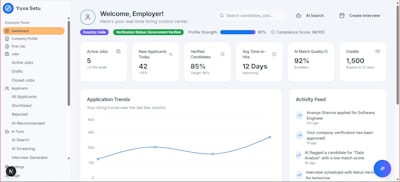
Fifth criterion: measurement and visibility. An intranet should not be a black box. The provider must offer dashboards to track adoption, onboarding times, knowledge queries and process impact. This is where business intelligence comes into play: integrating BI/Power BI tools helps leadership visualize key indicators and make decisions with real data. Before starting, the provider should propose measurable KPIs: time to full productivity, speed to find answers, satisfaction of new hires, reduction of repetitive issues. A simple dashboard that everyone consults is better than a complex scorecard that nobody uses.
Sixth criterion: autonomy and AI governance. Many solutions create a permanent dependence on the provider. A mature provider delivers mechanisms for your team to manage content, review recommendations, adjust workflows and supervise results. This includes AI governance: roles, approvals, logs and human supervision at critical points. Ask how models are updated, how accuracy is measured and who has control over automated decisions. Content lifecycle is also key: the intranet must allow any department owner to publish, update and remove information without writing code. Governance is not only technical; it is organizational. Define who approves AI-generated content and how often the system is audited.
Seventh criterion: cost and roadmap. Evaluate the economic proposal comprehensively: not only the initial development, but also maintenance, evolution and the cost of integrations. A good project is delivered in phases, with a first usable result in a few weeks and continuous improvements. Be wary of closed budgets without discovery work and of promises without metrics. Split the project into MVP, improvement and consolidation. This reduces risk and the provider demonstrates delivery at every stage. Price transparency is a sign of maturity: a provider that responds in detail to each invoice line creates more confidence than one that gives a global figure without explanation.
Eighth criterion: support, training and SLA. The intranet is critical and the provider must offer a clear support model with response times, channels and incident procedures. Value documentation and knowledge transfer. An intranet with smart onboarding involves organizational change: the provider must include training, guides and workshops so people understand how to use the tool and why it is better than the previous one. Also ask for an availability and maintenance calendar. Cloud, models and APIs evolve; you need to know how the provider updates the platform without breaking what already works.
Among the most common mistakes when evaluating providers are: comparing only prices, accepting a demo without a proof of concept, ignoring security, not talking to end users and not demanding business metrics. The selection process should include a pilot in a specific department, with real data and a follow-up committee. Big technical promises are better tested in practice than in brochures.
Conclusion: evaluating intranet providers with smart onboarding is an exercise in maturity. You need to look beyond the demo and focus on the ability to build a system that fits the culture, systems and goals of the organization. In this regard, Q2BSTUDIO represents a company profile that combines custom software development with AI integration, AWS/Azure cloud, cybersecurity and BI/Power BI, delivering measurable results and client autonomy. If your organization wants to take this step, it is worth starting a conversation with a team that understands technology as a means to generate value, not as an end in itself.