The corporate intranet has stopped being a simple document repository and has become the organization's nervous system. In an environment where information multiplies and talent is distributed across different locations, companies need a platform that not only organizes knowledge but also helps people integrate from day one. Smart onboarding is precisely the application of technology so that a new person understands the culture, processes, and tools of the company quickly and personally. Achieving this requires an approach where custom software development, artificial intelligence, and a solid cloud strategy work together. That combination of custom software, AI, and automation is what makes the difference for organizations.
The starting point for any intranet with smart onboarding project should not be technology, but a diagnosis of the real employee experience. Every organization has different hiring flows, departments, systems, and regulations. That is why a standard solution rarely delivers transformative results. The key is to observe the journeys an employee follows during their first weeks and detect friction points: documents they cannot find, credentials that arrive late, tasks that depend on emails, or contacts they do not know. On that basis, the technology partner can design a solution that reduces complexity and generates value from the first month.
Smart onboarding is not limited to a welcome course. Technology makes it possible to build dynamic experiences. For example, a centralized portal can offer personalized onboarding plans based on role, location, or experience level. AI agents can answer frequently asked questions, recommend training, remind about deadlines, and connect the person with the right managers. At the same time, automating administrative tasks frees HR staff from repetitive work and reduces errors. This combination of conversational assistance, automation, and contextual content is what makes a modern intranet stand out from a simple employee page.
For the intranet to be truly useful, it needs to integrate with systems the company already uses: people management tools, ERP, CRM, active directory, or productivity suites. An isolated platform turns onboarding into a fragmented experience. Integration allows data to flow between systems, permissions to be managed centrally, and information to remain current. Here custom development plays an essential role, because no two infrastructures are identical. The ability to connect APIs, synchronize databases, and adapt workflows is a technical requirement that cannot be improvised.
Artificial intelligence adds an intelligence layer that transforms information search. Instead of browsing folders, the person asks a question and the system locates the most relevant answer in manuals, policies, minutes, or previous conversations. Natural language models, augmented retrieval, and intelligent agents make a company's historical knowledge available to everyone. In addition, AI can suggest actions, detect knowledge gaps, and offer proactive content. The goal is not to replace human judgment, but to expand people's ability to access what they need at the right moment.
Deploying these capabilities requires a solid infrastructure. The cloud has become the standard for ensuring scalability, availability, and security. Working with platforms like AWS or Azure allows the intranet to grow with the number of users, keep data protected with encryption, and meet residency policies. The choice between public, private, or hybrid cloud will depend on data criticality and sector. A partner with experience in Azure and AWS cloud services will know how to recommend the most suitable architecture and avoid unnecessary costs.
Cybersecurity cannot be an afterthought. Any intranet handles personal data, financial information, and strategic knowledge. An improper access or a leak can have serious legal and reputational consequences. Therefore, the design must include multi-factor authentication, role-based access control, encryption in transit and at rest, event auditing, and protection against external threats. In environments where AI interacts with internal data, it is also necessary to apply isolation policies, secure connections, and human oversight for critical decisions. Security is a joint responsibility between technology and governance.
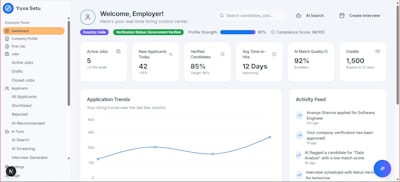
Measuring results is another pillar. An intranet with smart onboarding must be evaluated with clear indicators: time to productivity, employee satisfaction, reduction of manual tasks, information quality, and platform adoption. Dashboards and business intelligence tools, such as Power BI, allow this data to be visualized in real time. This way, people and operations managers can make evidence-based decisions. Technology is not an end in itself; it is a means to improve business outcomes.
Choosing the right partner is a strategic decision. Finding a company that knows how to program is not enough. Specialists in software architecture, integration, artificial intelligence, security, and change management are needed. It is also important to assess the working methodology: how discovery is carried out, how scope is defined, how risks are managed, and how success is measured. A good partner supports the organization beyond go-live, with support, maintenance, and continuous evolution.
Q2BSTUDIO is a software development company that approaches this type of project with a comprehensive vision. Its team combines experience in custom applications, system integration, artificial intelligence, automation, and cloud. For an intranet with smart onboarding, they propose a discovery phase in which real workflows are mapped, dependencies are identified, and baseline indicators are defined. Then, they deploy a minimum viable product in a few weeks to validate hypotheses and adjust the approach before scaling to the entire organization.
One of the differentiating aspects of Q2BSTUDIO's approach is that they do not lock the client into a closed system. Solutions are delivered with source code, documentation, and administration portals so that the internal team can operate the AI, update content, and monitor performance without depending on consultants for every change. This autonomy reduces total cost of ownership and accelerates product evolution. In addition, the use of AI agents is governed by clear policies, with human oversight and traceability for every relevant decision.
Investing in an intelligent intranet should be understood as a bet on structural efficiency. Benefits usually appear as faster onboarding, fewer operational errors, greater team satisfaction, and better internal communication. To justify the project to the finance department, it is worth defining from the start a business case with indicators, payback periods, and risks. A serious partner must be able to explain how impact will be measured and how adoption by employees will be ensured.
The future of corporate intranets lies in the convergence of knowledge, automation, and artificial intelligence. Organizations that provide their teams with contextual and intuitive tools will have an advantage in attracting talent and operating with agility. Technology does not solve communication problems by itself, but a well-designed platform can remove barriers and free up time so that people focus on what really adds value.
In short, finding the best partner for an intranet with smart onboarding means evaluating technical capacity, real experience, methodology, and commitment to security. The right solution combines custom software, integration with the existing ecosystem, artificial intelligence applied to concrete cases, and flexible cloud infrastructure. Companies like Q2BSTUDIO represent that vision because they understand that technology must serve a clear and measurable business strategy.