Internal communication is not a luxury: it is the nervous system of any organization. As a company grows, information tends to fragment across email, chats, shared folders and disconnected tools. The result is an employee who does not know who to ask, a manager who repeats instructions and an onboarding process that stretches the productivity curve for weeks. Against this scenario, an intranet with smart onboarding solves the problem at its root: it unifies communication, automates tasks and turns every interaction into useful business data.
Many companies still view the intranet as a static document repository. That model no longer meets the needs of teams that work with agility and need immediate answers. A modern intranet must be a living workspace: a place where people find the right information, receive relevant notifications and collaborate without friction. To achieve this, installing a template is not enough. It takes an engineering approach that combines custom software development, system integration and a design focused on the employee experience.
Q2BSTUDIO is a software development and technology company that builds intranets with smart onboarding for organizations that want measurable results. Its approach starts by understanding internal processes, technological constraints and business objectives; then it designs a solution that does not force companies to replace legacy systems, but rather extends their value through APIs, connectors and automation. This allows the intranet to coexist with ERPs, CRMs, document platforms and identity services.
Smart onboarding is much more than a welcome manual. It is about creating a guided experience where each new employee knows what to do, with which tool and in what order. The intranet can assign tasks, remind milestones, request documentation and provide access to resources according to each role. The whole process is recorded and visible to HR, making it possible to correct deviations and continuously improve the experience.
Artificial intelligence multiplies the potential of this tool. Thanks to language models and AI agents, the intranet can interpret natural-language questions, search internal documents and provide contextual answers. For example, an employee can ask how to request time off and receive the exact procedure without waiting for a colleague. Q2BSTUDIO integrates these capabilities through APIs, Azure AI Foundry, AWS and hybrid architectures that protect sensitive information.
Behind these functionalities there are relevant architecture decisions. Applications are deployed in AWS/Azure cloud environments to ensure availability and elasticity, while corporate data can remain on local systems through secure connections. Q2BSTUDIO applies security-by-design principles: role-based access control, encryption in transit and at rest, audit logging and regulatory compliance. Cybersecurity is not an add-on; it is a cross-cutting layer that protects both the user and the organization.
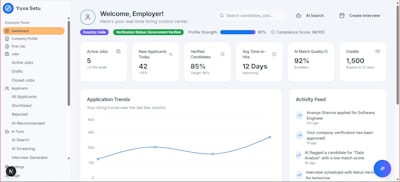
Another pillar is observability. An intranet with smart onboarding generates a large amount of data: completion time, number of resolved queries, adoption rates, employee satisfaction. With BI and Power BI tools, Q2BSTUDIO turns that data into dashboards accessible to management, HR and team leaders. This visibility supports evidence-based decisions, detects bottlenecks and demonstrates return on investment to the finance department.
The effect on internal communication is immediate. Instead of relying on crossed emails and status meetings, teams work with shared dashboards, automatic alerts and collaborative spaces that retain the context of every decision. Smart notifications avoid information overload: only what is relevant to each person is shown at any given moment. The intranet stops being a mailbox and becomes a coordination platform.
Implementation follows a pragmatic methodology. First, current flows and key indicators are analyzed to determine what needs to improve. Then a minimum viable product is defined to validate assumptions in a few weeks. After that, existing systems are progressively integrated and more advanced capabilities are added, such as AI agents, process automation and reporting. Q2BSTUDIO supports the organization throughout the cycle, including team training and post-launch optimization.
For technology leaders, this type of project involves less risk than it seems. Because the current ecosystem is not replaced, operational impact is reduced and adoption is accelerated. Moreover, the client owns the source code, avoiding unnecessary vendor lock-in. That is a key difference from closed solutions that prevent the business from evolving at the speed it needs.
From a business perspective, the benefits are tangible: faster onboarding, clearer communication and a reduction in repetitive administrative tasks. HR can spend more time caring for talent and less time chasing signatures or answering recurring questions. Middle managers gain visibility over the real state of their teams. And employees feel that the company offers them technology that makes work easier.
A well-executed intranet with smart onboarding project must be measurable. Q2BSTUDIO recommends defining KPIs at the beginning: average time to productivity, employee satisfaction level, number of automatically resolved queries, percentage of tasks completed on time and reduction of operational errors. This information makes it possible to adjust the solution and justify the investment with real data.
In short, internal communication is a battlefield for productivity. An intranet with smart onboarding not only improves the employee experience; it also creates a sustainable competitive advantage. Organizations that choose custom technology and AI integrated into workflows are better prepared to attract talent, operate efficiently and adapt quickly to change.
Q2BSTUDIO helps companies of all sizes design and build these solutions with a balance between innovation, security and cost. If your organization needs to improve internal communication and digitize the onboarding process, the next step is to turn this need into a concrete plan. An initial consultation helps identify improvement opportunities, prioritize actions and estimate the required effort.
Working with a technical team that understands the problem from both a strategic and an engineering perspective makes the difference. Technology should serve the business, not the other way around. With an intranet based on custom software, cloud, AI and automation, internal communication stops being a weak point and becomes a real growth lever.