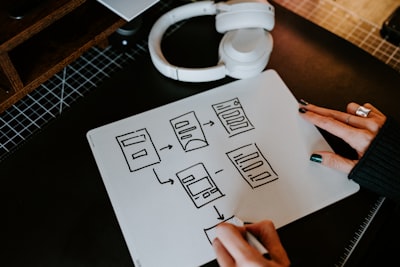
Business application development has become a strategic lever for companies that need to digitize processes, improve decision-making and deliver solid digital experiences. Far from being limited to writing code, this discipline combines process analysis, technology architecture, user experience, system integration and security. Every project starts with a specific question: what business problem do we want to solve and how do we measure its impact?
To answer this, the product and technology team works together with business stakeholders. They diagnose current operations, identify friction points and define key performance indicators that will measure the success of the solution. This stage does not end with a document: it becomes a living roadmap that guides design, development and evolution decisions.
Next, the application architecture is defined. At this point it is essential to choose a scalable technology foundation. Many organizations choose cloud AWS/Azure services to take advantage of elasticity, high availability and automation capabilities offered by these platforms. A well-designed architecture lets the application adapt to business growth, handle demand spikes and support continuous deployment of new features.
In parallel, user experience design focuses on the people who will use the application. An operations director does not need the same interface as a field technician or an external customer. Therefore, enterprise applications are built with differentiated user profiles, guided flows and visual panels that anticipate each role's needs. The goal is to reduce the learning curve and avoid technology becoming a barrier.
Development itself is organized through agile methodologies. Teams work in short delivery cycles with continuous client review. Each sprint produces a usable version that is tested and validated with real data. This way of working reduces risk and allows changes to be incorporated on the fly. Constant communication with the project team is one of the factors that most influences the final result.
A fundamental piece is integration with corporate systems. Business applications rarely work in isolation. They need to connect to ERPs, CRMs, invoicing systems or Business Intelligence tools. This is where APIs, native connectors and integration layers that unify data come into play. With a BI platform such as Power BI, for example, it is possible to visualize in real time the information generated by the application and make decisions based on facts, not intuition.
Artificial intelligence has opened a new level of possibilities. An enterprise application can incorporate AI models to classify incidents, predict demand, recommend actions or process documents automatically. In some cases, AI agents act as assistants that guide users inside the application, answer frequent questions and automate repetitive tasks. Integrating these capabilities is not an end in itself; it must always be done with a clear business purpose and quality data.
We cannot talk about application development without considering cybersecurity from the first line of work. Enterprise applications handle sensitive information: customer data, finance, industrial property or internal records. A security failure can compromise trust and business continuity. Therefore, access controls, encryption in transit and at rest, secure credential management and periodic audits are applied. In addition, pentesting processes allow vulnerabilities to be detected before attackers do.
Quality assurance includes functional, performance, compatibility and security testing. Each release is prepared with a deployment strategy that minimizes the impact on operations. In cloud environments, continuous integration and deployment practices allow the application to be updated without interrupting service. This is especially relevant when the application is already in production and supports critical processes.
Once in production, the work does not end. Business needs change and applications must evolve. Product teams analyze usage metrics, collect user feedback and prioritize improvements. This feedback turns every development into a continuous improvement cycle. Companies that understand this point obtain a much higher return on investment: the application does not age, it adapts.
In this context, having a technology partner that brings both technical and business vision is decisive. Q2BSTUDIO, as a software and technology development company, accompanies organizations throughout the entire application lifecycle. Its approach is based first on understanding the client's operational and decision-making process, and then proposing the most suitable solutions. It is not about imposing a technology, but about building a sustainable solution aligned with strategic objectives.
Q2BSTUDIO builds custom software for web, mobile and multiplatform environments. These projects make it possible to eliminate the limitations of standard products and create flows that reflect exactly how each company works. Moreover, its experience in cloud AWS/Azure, artificial intelligence, cybersecurity and Business Intelligence makes the application not just a digital tool, but a complete transformation platform.
For example, an industrial company can commission an application to digitize quality inspections. The application records operations at the point of work, validates data against the ERP, applies rules defined by the quality team and sends results to a Power BI dashboard. If a measurement falls out of range, an AI agent detects the anomaly and notifies the person in charge. This is a realistic case of how the pieces of enterprise development fit together.
Another common case is application development for sales teams. A company that works with external agents needs a tool that works offline, synchronizes data with the CRM and allows each customer's history to be consulted. Custom software must be lightweight, intuitive and ready to work in mobile environments. Behind that visible simplicity there is integration, security and architecture work that involves several IT areas.
The value of business app development is not measured by the number of features, but by business outcomes. How much time is saved? How many incidents are reduced? What data is now available that did not exist before? These are the questions that drive a serious project. When technology aligns with processes and people, a real improvement in productivity and customer and employee experience occurs.
For a project to be successful, it is advisable to start with a clear scope and an iterative approach. It is not necessary to build the definitive solution in the first launch. A first version with critical functionality allows measuring impact and learning quickly. Then, each iteration incorporates improvements based on data and real usage experience. This agile philosophy is especially useful in environments where priorities change frequently.
Technology choice should also be made with criteria. Not all applications need artificial intelligence, nor all support millions of users. The design must fit the company's context. At this point, knowledge of platforms such as AWS and Azure helps to size infrastructure correctly and control costs. An application that does not properly leverage the cloud can generate overspending or performance problems.
Cybersecurity must also be proportional to risk. An internal app for a small team does not require the same level of control as an app with customer access and payment data. Even so, every enterprise application should include good security practices from the start. Working with specialists in pentesting and audits provides an additional guarantee, especially in regulated sectors.
In short, business application development is an integral process that goes from identifying the problem to continuously evolving the solution. It involves mastering technical aspects, but also understanding operations, people and data. Companies that approach this path with a strategic vision obtain competitive advantages that are difficult to replicate.
Q2BSTUDIO positions itself as an ally in this process. Its team integrates technical and functional profiles capable of tackling complex projects involving custom software, cloud, AI, data and security. The company works with a clear methodology, constant communication and modern tools, so that the client knows at every moment what is being built and why. In the end, success is measured in business terms: greater efficiency, faster decisions and a better digital experience. Taking app development seriously builds an advantage that lasts.