Intranets with workflow automation are a powerful solution, but not a universal one. Many companies discover that their operational reality requires lighter, faster or more specific answers than a comprehensive corporate platform.
The need to automate internal processes usually appears when employees spend hours on repetitive tasks, when manual errors multiply or when operational visibility is blurred. At that point, the decision between implementing a complete intranet or looking for alternatives can make the difference between a project that generates value and one that becomes an administrative burden.
This article reviews the most practical alternatives, their limits and the criteria for choosing well. It covers point solutions, generic automation tools, low-code platforms, custom development and the hybrid approach. The goal is to offer a decision guide for those who do not want to marry a single technology.
Point solutions are the most immediate option. They consist of adopting a specialized tool for a single workflow: for example, electronic contract signing, expense management or vacation approval. They are cheap, implemented in days and the IT team barely participates. The downside is that they generate isolated data, do not provide a unified business view and, when many tools accumulate, the administration cost goes up again.
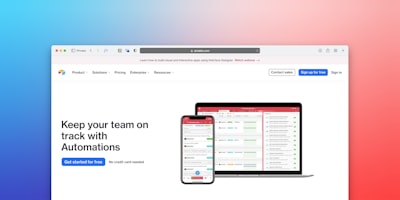
Generic automation tools such as Zapier, Make, n8n or Microsoft Power Automate occupy the next level. They allow connecting applications through triggers, conditions and actions. A typical example is creating a task in the project manager when an email with a certain subject arrives. They are very useful for light workflows, give autonomy to the business and cost less than complete development. However, they have important limits: complex logic becomes hard to maintain, high data volumes affect performance, and dependence on external services can compromise corporate data privacy.
Low-code and no-code platforms occupy an intermediate space. Tools like Airtable, Glide, AppSheet or Mendix allow building dashboards, task managers or small internal applications without advanced programming training. The appeal is evident: business teams can launch solutions in weeks and adjust them constantly. The problem appears when the solution grows. Without version control, automated tests or a clear architecture, the application becomes a technical debt hole. In addition, data security usually remains in the hands of the platform provider, something to assess rigorously in regulated sectors.
In-house development is the classic alternative. An internal engineering team designs, builds and maintains the entire system. It is the option that offers the most control, both functional and security-wise. But it requires a stable payroll of developers, deployment tools, a product roadmap and constant coordination with users. For a large corporation, it makes a lot of sense if the number of digitized processes is high. For an SME, the opportunity cost is rarely justified.
The hybrid approach has become the most balanced answer. It consists of keeping an intranet or a central portal for core processes, while allowing the edges of the organization to use light tools or targeted automations. In this way, data coherence is obtained in critical areas and adaptation speed in peripheral ones. The challenge is to define which is the core and which is the edge, and to establish clean connectors between both.
To make the right decision, comparing prices is not enough. It is necessary to consider the digital maturity of the team, the expected life cycle of the solution, the integration requirements with the ERP or CRM, and data protection regulations. A small diagnosis should be carried out before choosing: list the candidate workflows, measure their frequency, identify the systems involved and ask what happens if the service fails.
At this point, AI and AI agents have introduced a qualitative change. Traditional workflows were deterministic: if X happened, Y was done. With agents, the system can interpret unstructured data, hold a conversation in natural language or decide how to complete a complex task. An agent that reads an invoice, checks it against a purchase order and updates the ERP no longer needs fixed rules: it understands the context. This is one of the reasons why many companies are reconsidering their alternatives to the classic intranet.
Cloud architecture also changes the balance. AWS and Azure offer managed services for databases, message queues, containers and machine learning. This reduces the complexity of operating an infrastructure and makes it easier to scale when the business needs it. An organization that already bets on cloud strategy can build custom solutions more easily, because it does not start from scratch. Therefore, when evaluating alternatives, the provider must demonstrate experience in cloud deployments, not just in a PowerPoint.
Cybersecurity is the other pillar. Every alternative will involve moving data between systems, and that movement must be protected: encryption in transit, role-based authentication, audit logging and continuous monitoring. In sectors such as healthcare, banking or industry, regulation is demanding. If the alternative cannot be integrated into an already defined corporate security policy, it is likely to cause more problems than benefits.
Visibility of results must also be taken into account. An automation project that is not measured is a project without direction. Integration with Business Intelligence and Power BI tools makes it possible to represent process times, error rates and cost per operation on a dashboard. This is how investment is justified to management and how to quickly detect if an alternative works or needs adjustments.
When the company needs to go beyond the standard, the most solid option is usually the custom software development. An application built specifically for the company's processes adapts to its business rules, integrates without friction with existing systems and is deployed on the infrastructure chosen by the client, usually with AWS or Azure cloud services. Custom development takes a little longer than a low-code tool, but technical debt, provided you work with a competent team, is much lower.
That is where Q2BSTUDIO positions itself naturally. Its team combines software engineering, process automation, artificial intelligence and cybersecurity. Instead of pushing a license, it offers a diagnosis, proposes the most appropriate alternative and develops it in phases, so the client can validate results along the way. This way of working fits especially well in projects where the traditional intranet is too heavy and generic tools too limited.
For example, some projects start with the automation of a specific workflow in the tool already in use, and grow with a Power BI dashboard to monitor performance. Others need an internal panel with AI that groups information from several departments. Q2BSTUDIO supports both scenarios with a practical, data-driven approach.
It is worth insisting that choosing an alternative does not mean giving up growth. A company can solve a problem today with a point solution and, tomorrow, build a more complete platform when processes are mature. Automation is not a destination, it is a continuous improvement method. Technology must adapt to the organization, not the other way around.
In conclusion, alternatives to intranet with workflow automation are varied. Point solutions, generic tools, low-code, custom development and hybrids offer different balances between cost, control and speed. The right choice depends on context, timing, internal skills and compliance requirements. Carefully analyzing these criteria before investing saves money and headaches.
If your organization is considering any of these options, Q2BSTUDIO offers a free discovery session to study your case with technical criteria. It is not about selling a platform, but about finding the solution that best fits your goals and your maintenance capacity.