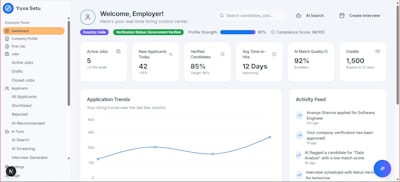
The corporate intranet has ceased to be a simple document repository. In practice, it has become the nervous system that connects teams, processes, and data on a single platform. When automation is also incorporated, the result is an environment in which repetitive tasks run by themselves, information flows without friction, and people can focus on decisions that create value. The key to making that transformation work is not only technology: it is the way the team adopts the solution and the documentation that accompanies each change.
At Q2BSTUDIO we know this from experience. For years we have been helping companies of all sizes launch intranets that integrate artificial intelligence, automation, and business data. We also know that a project can be technically flawless and still fail if users do not understand it, do not accept it, or cannot find answers to their questions. This is why onboarding and documentation are a central part of our methodology, not an optional extra.
When we talk about an intranet with automation, we mean a digital workspace where employees consult information, collaborate, and trigger internal processes without depending on the IT department. Requesting time off, approving an expense, onboarding a new employee, classifying a supplier, or generating a sales report are typical examples of workflows that can be automated. The intranet acts as the single point of entry, and the automation engine orchestrates the tasks behind the scenes.
Launching such a solution is not like installing a desktop program. It requires a prior analysis of the processes to be streamlined, the systems with which integration is needed, and the indicators that will make it possible to measure progress. At Q2BSTUDIO we usually start with a discovery phase in which we listen to the departments involved, identify bottlenecks, and define an objective starting point. On that basis, we design a roadmap with phased deliveries, so that the first versions go into production within weeks and the teams begin to obtain value from the very beginning.
During those first weeks, documentation is already present. We do not wait until development is finished to start writing manuals. At the same time as the modules are built, we write user guides, frequently asked questions, quick reference cards, and technical descriptions of the integrations. This documentation is reviewed with the users themselves in training sessions and adjusted with their feedback. The result is a set of materials that reflects the real application, not a theoretical vision of what it should be.
Training, for its part, is designed to accompany the change in habits. A team that has worked for years with email and spreadsheets is not going to change its routine overnight. That is why onboarding includes workshops aimed at different profiles: employees, administrators, and executives. Each profile needs a different level of detail. Administrators must understand how permissions are managed, how actions are audited, and how automated workflows are configured. Executives need to see how the tool helps them make decisions and how they can measure the impact on business indicators.
One of the aspects our clients value most is the ability to adapt technology to existing processes. We do not start from a rigid template, but from custom software that integrates with the systems the company already uses. This reduces the learning curve, avoids duplication and allows the intranet to coexist with an ERP, a CRM, or a document management platform without forcing traumatic migrations. Thanks to this approach, automation becomes a layer that connects tools, not a project that forces replacing them.
Process automation, moreover, can range from simple alerts to complex orchestrations with several validation levels. For example, a purchasing process can include approval rules, budget checks, notification sending, and automatic ERP updates. To avoid risks, we keep human oversight at critical points. This aligns with what is now called human-in-the-loop, a concept that Q2BSTUDIO applies in a practical way: technology eliminates mechanical work, but people retain control over important decisions.
In this context, artificial intelligence makes full sense. It is not about adding AI as a trend, but about using it where it truly contributes. A semantic search engine inside the intranet can help employees find answers instead of documents. An AI agent can draft a first version of a response, summarize a long thread, or classify incoming requests. It is also possible to train models with internal documentation so that the virtual assistant responds coherently and cites its sources. All this requires a secure architecture, with access control and activity logging. That is why we speak of process automation as a discipline that combines software, data, and governance.
Information visibility is another pillar. An automated intranet generates a great deal of data about its own use: how many workflows are executed, how much time is saved, which processes get stuck, which users need more training. To take advantage of that data, we integrate dashboards in BI/Power BI and other Business Intelligence tools. These panels allow project managers to see the evolution of key indicators and detect opportunities for improvement before they become problems. Documentation also covers how these indicators are built, so that the client can interpret them autonomously.
Another factor we cannot ignore is security. An intranet concentrates confidential information and, if it is connected to an ERP or a corporate directory, it becomes an attractive target. That is why deployment relies on cybersecurity practices: centralized authentication, roles, granular permissions, auditing of actions, and encryption in transit and at rest. When the solution needs to communicate with systems located on the company's premises, we use AWS/Azure cloud with secure connectivity, for example VPN tunnels and private endpoints. In this way, AI models and automated processes can access necessary data without exposing it to the internet.
The documentation we deliver is not a static document. It is updated continuously as functionality is added or lessons learned are detected. To achieve this, we use a knowledge portal where the client can check the status of each integration, current configurations, and usage policies. Teams also receive an adoption plan with responsible parties, milestones, and usage metrics. It is not about handing over an instruction manual, but about creating a collective learning system that evolves with the product.
In the end, the question every executive asks is whether the investment is worthwhile. Our answer is supported by observable data: reduced cycle times, fewer manual errors, fewer administrative tasks, and higher employee satisfaction. Documentation and onboarding contribute directly to these results because they ensure the tool is truly used. An automated intranet that nobody uses is a cost; a well-adopted intranet is a productivity lever.
At Q2BSTUDIO we offer onboarding and documentation for intranet with automation because we believe that technology only demonstrates its value when people integrate it into their daily work. From the initial discovery to continuous evolution, we accompany the client with training, reference materials, and a team of specialists in software development, AI, cloud, cybersecurity, and data. Thus, the intranet ceases to be a project with an end date and becomes an internal capability that the company can manage and grow with confidence.