The intranet with workflow automation has evolved from being a simple document repository to becoming an essential operational piece. Companies use it to structure internal communication, accelerate decisions, manage approvals and connect data that until now lived in separate systems. However, the true value lies not in technology itself, but in the ability to adapt to each organization. That is why it is worth asking how flexible an intranet of this type really is and what conditions must be met for that flexibility to translate into results.
A first dimension of flexibility is user experience. Business areas do not work the same way: sales needs visibility over the pipeline, HR manages staffing and training requests, operations coordinates maintenance and quality tasks. A flexible intranet allows each area to have its own view, with configurable navigation, role-based menus, contextual dashboards and support for mobile devices. Users should not have to call the technical department to rearrange a dashboard; the platform should allow simple adjustments within established permissions.
Flexibility also extends to how processes are defined and modified. An intranet with workflow automation should not force the company to fit its operations into rigid templates. On the contrary, it makes it possible to model workflows with different levels of complexity: from a simple request to a process with multiple approvals, conditional branches, deadlines, reminders and escalations. Moreover, business logic can be updated in a controlled way, with versioning and testing, without putting daily operations at risk.
Another key aspect is integration capability. Organizations already have systems that are not going away: ERPs, CRMs, BI tools, email platforms or document managers. A flexible intranet needs to coexist with all of them. To achieve this, it is common to rely on custom software or a layer of custom applications that connects processes with the APIs of existing systems. This way, what works is not replaced; it is extended.
The cloud is a natural ally of flexibility. An architecture based on AWS or Azure allows scaling resources according to demand, deploying new versions in separate environments and moving toward a continuous integration model. At the same time, the cloud facilitates connection with corporate services such as Active Directory, SharePoint or Microsoft Teams, so users access the intranet from their same work environment. The combination of cloud and bespoke code is one of the most solid ways to achieve a truly adaptable intranet.
Artificial intelligence adds another layer of flexibility that is difficult to achieve with traditional software. Semantic search, document summarization and AI agents allow the intranet to understand user intent and deliver direct answers. But AI is not a predefined component: models must be adjustable to the data, vocabulary and policies of each company. For this reason, a flexible intranet incorporates customization mechanisms, such as RAG architectures, natural language processing and the possibility of deploying private models when the sector or the client requires it.
It is important to understand that flexibility without control is a risk. An intranet that automates sensitive workflows needs cybersecurity at all levels. This means role-based access management, traceability of actions, change audits, personal data protection and human supervision mechanisms in the most delicate processes. It also involves designing secure communications, for example through VPN or private endpoints, when AI interacts with on-premises systems. Security, when well implemented, does not limit flexibility; it makes it viable.
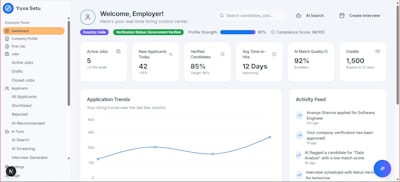
Flexibility is also demonstrated in the ability to measure and improve. An intranet with workflow automation continuously generates data: process times, compliance rates, workloads, service levels. If that data is connected to Business Intelligence or Power BI tools, management obtains complete dashboards and can detect bottlenecks, redistribute workloads or redesign processes with objective information. That is the basis for continuous improvement: every change increases flexibility because it is validated with real data.
Flexibility is also reflected in governance. Not all processes require the same level of control. A material request can be managed with simple rules, while a hiring file must go through several validations and leave evidence. A flexible intranet makes it possible to define policies by process type: who can start it, who must approve it, what data is visible and which actions are recorded. That granularity allows automation to coexist with each area's audit and compliance requirements without becoming a burden for teams.
Another sign of flexibility is the ability to test before rolling out. It is not necessary to deploy an automation across the whole company at once. It can start with one team, one office or one type of request, compare results with a control group and adjust the configuration before expanding it further. This incremental approach reduces risk, facilitates adoption and makes it possible to show real progress in the first weeks. It also helps prioritize the workflows that generate the greatest impact based on evidence, not assumptions.
Flexibility is also demonstrated in the life cycle. An intranet project does not end when it goes into production; it evolves with the business. A phased delivery, with a minimum viable product in a few weeks, allows early results and expands the solution incrementally. Modular architecture and agile development make it possible to add new features, integrate another system or reconfigure a workflow without stopping daily operations. In this way, the intranet becomes a platform that grows with the organization.
Q2BSTUDIO approaches intranet construction from this perspective. As a software development company, it combines custom software, process automation, AI, cloud, cybersecurity and BI to deliver platforms that support business evolution. Its approach includes an initial discovery phase, a prioritized roadmap and a web administration portal so the client can manage much of the logic without depending on the provider. Thus, the initial question finds an answer: an intranet with workflow automation is as flexible as the architecture and approach of the team that builds it.