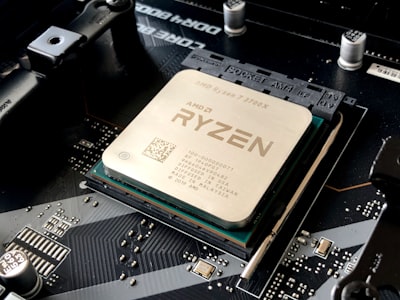
The ecosystem of high-performance laptop processors is experiencing a new shake-up. Benchmark leaks suggest that the upcoming AMD Zen 6 'Medusa Point' with 10 cores has outperformed the recent Ryzen AI 9 HX 370 in Geekbench — a chip designed for artificial intelligence and advanced productivity. Beyond the hype, this result implies a deep architectural leap that deserves thorough technical analysis, and also resonates in the world of software development and digital business transformation.
The test, published on benchmark platforms, shows a single-core score above 3,200 points and multi-core performance approaching 18,000. For context, the Ryzen AI 9 HX 370 (based on Zen 5 with a dedicated NPU) scores around 2,900 and 15,000 respectively. The improvement is not trivial: Zen 6 introduces a new microarchitecture with changes in cache hierarchy, higher instruction bandwidth, and a manufacturing process optimization that allows sustained higher frequencies without skyrocketing power consumption. All this with a TDP that, according to sources, stays in the typical 28–45 W range of the H series.
What makes 'Medusa Point' interesting is that it not only improves IPC (instructions per cycle) but also integrates a third-generation NPU. This is crucial for running local artificial intelligence models — tasks like natural language processing, image recognition, or virtual assistants can execute without relying on the cloud. For companies developing custom software, having hardware that accelerates AI inference on the device reduces latency and improves data privacy.
From a cybersecurity perspective, this local capability is a double-edged sword. On one hand, it allows security agents to analyze traffic or detect anomalous behaviors without sending sensitive data to external servers. On the other hand, it increases the attack surface if the chip or its firmware has vulnerabilities. That is why at Q2BSTUDIO we always recommend complementing any hardware deployment with pentesting and security audit services, such as those we offer in cybersecurity, to ensure that both the physical and logical layers are protected.
The performance of Medusa Point also has direct implications for hybrid cloud. With such a powerful CPU, workloads that previously required expensive instances on AWS or Azure can now run locally on client devices. This opens the door to edge computing architectures where preprocessing happens on the device and only aggregated results travel to the cloud. At Q2BSTUDIO we help companies design these solutions, integrating cloud AWS/Azure with cutting-edge hardware to optimize costs and performance.
Another relevant aspect is real-time data analytics. With 10 high-performance cores, Business Intelligence (BI) processes that require heavy data transformations — like those handled by Power BI — can run directly on the processor without additional servers. This accelerates reports and dashboards, enabling users to make data-driven decisions almost instantly. At Q2BSTUDIO we implement BI/Power BI solutions that fully leverage local power when data volume justifies it.
But we cannot forget the role of generative AI and autonomous agents. A processor with greater client-side compute capacity allows running larger language models without relying on external APIs. This reduces recurring costs and gives full control over data. For instance, an AI agent for customer service can run entirely locally with latency under 10 ms. At Q2BSTUDIO we develop custom AI agents that benefit from this kind of hardware, providing contextual and secure responses.
Returning to the comparison with the Ryzen AI 9 HX 370, it is worth noting that the latter already introduced AMD's XDNA 2 NPU, with 50 TOPS of AI performance. Medusa Point, according to leaks, would reach 60 TOPS, reinforcing its position as the preferred platform for software developers working with frameworks like ONNX Runtime or TensorFlow Lite. For a company that develops process automation software, having such CPUs means that workflows involving computer vision or document processing can run in real time without compromising security.
On the business side, the arrival of Zen 6 Medusa Point comes at a time when demand for devices with local AI capability is growing. Companies in sectors like healthcare, finance, and logistics are looking for laptops that can run machine learning models without sending data to the cloud. This not only meets privacy regulations (GDPR, CCPA) but also reduces reliance on internet connections. Q2BSTUDIO, as a software and technology development company, advises its clients on hardware selection and application migration to these new platforms, ensuring that software is optimized for Zen 6's specific instructions.
From a technical standpoint, Medusa Point's architecture introduces a new core design called 'Medusa Core,' which improves branch prediction and speculative execution. This reduces prediction errors by 15% compared to Zen 5, meaning fewer wasted cycles. Additionally, the shared L3 cache increases to 32 MB, benefiting workloads with large data sets, such as those found in BI and statistical analysis systems.
Competition with Intel Arrow Lake also intensifies. While Intel bets on hybrid cores (P-core and E-core), AMD maintains a homogeneous configuration of 10 high-performance cores. This simplifies task scheduling and avoids the complexity of managing different core types. For developers of custom software, this uniformity is an advantage because applications do not need special logic to assign threads to specific cores.
Finally, it is important to reflect on the impact on the mobile workstation market. Engineering, 3D design, and data science professionals will find Medusa Point an ally for simulations and renders. For example, a render that previously took 40 minutes on a Ryzen AI 9 HX 370 could drop to 30 minutes with Zen 6. That time saving, multiplied by hundreds of projects per year, translates into significant productivity improvements.
In conclusion, the rumor that the Zen 6 Medusa Point 10-core outperforms the Ryzen AI 9 HX 370 is not just a benchmark story; it is a symptom of where computing is heading. The integration of AI capabilities, higher performance per watt, and compatibility with hybrid cloud infrastructure make this processor a key piece for companies seeking innovation. At Q2BSTUDIO, we closely follow these evolutions to offer our clients software solutions that get the most out of the latest hardware, whether in the form of custom applications, intelligent automation, or robust cybersecurity systems.